This site is Free & Ad-Free!
If you find this piece worthwhile, please donate via PayPal to support it & independent Art writing.
Other ways to support it at the end. Thank you!
Written & Photographed by Kenn Sava (*- unless otherwise credited)
Show seen: Marcel Duchamp at MoMA

LHOOQ, or LOOK, or “She has a hot ass” on a Mona Lisa Postcard.
With all the attention on everything that came later in Marcel Duchamp’s long career, like the mustachioed Mona Lisa postcard, L.H.O.O.Q., 1919, above, the Bicycle Wheel, 1913, among many others, it’s all too easy to forget that Duchamp (1887-1968) started out as a Painter. So, it was the very rare chance to see the overview of his Paintings included in MoMA’s Marcel Duchamp, the first U.S. Retrospective show of the Artist in 50 years, that most intrigued me.

The entrance lobby. Press Previews are too early for me, so I have to wait a long time to get these shots during normal hours. When I finally get one like this, it feels like the show is open just for me. Or you. Anonymous Photographer, Broadway Photoshop, NY, Multiple Portrait of Marcel Duchamp, 1917 surrounds The Chess Game, 1910, center. Marcel Duchamp would “retire” (sort of) from Art to focus on chess, his other obsession, later in his career.
With 300 pieces spanning his 68-year career far more than Paintings were on view in one of the largest shows I’ve ever seen. After an opening gallery of early Paintings & Drawings from 1900-10 that saw the Artist “trying on” styles borrowed from Degas, Gauguin, Cézanne and others, in 1911 he embarked on something his own. In only the 2nd of 9 galleries, 3 works on its last wall stopped me in my tracks.

Out of the darkness, a wall with three Paintings that grabbed me and haven’t let go. Nude (Sketch), Sad Young Man in a Train, 1911 (Dated 1912), left, Nude Descending the Staircase, (No. 2), 1912, center, (No. 1), 1911, right. A copy of the very comprehensive Exhibition Catalogue lies on the bench.
I became obsessed with one Painting and one question, that ran incessantly through my mind over what would be 5 visits to the show, a number that would have been doubled had I not been limited by health issues-
HOW did Duchamp come up with this?-

Nude Descending a Staircase, (No. 2), 1912, Oil on canvas.
As far as I know, t’s unprecedented in Art history to 1912, and remains singular since. The only three Paintings Duchamp did in this style I know of are on that wall. Brilliantly executed, with exquisitely controlled chaos, I’d never seen anything like Nude Descending a Staircase, (No. 2). Well, except when I saw it twice before- the first time in 2005 in the Philadelphia Museum of Art, who own it, and then in 2013 in the 100th Anniversary recreation of the legendary 1913 Armory Show, which introduced it to U.S. audiences in NYC & Chicago, at the NY Historical. 13 years ago is enough distance for it to leave a fresh impression. Seeing it now in the context of his Paintings up to 1912, and the only two other works in this style, floored me. The jump between what he had been doing and this is a giant leap. It left me feeling it was, at once, a gambit raising the stakes on the Cubists, and again, one of the boldest declarations that “I have arrived!” in Art history and certainly in Modern Art history. Marcel Duchamp was 26 when he Painted it. After being rejected for inclusion in a show in Paris because he was asked to, and refused to, change its title, he allowed it to be shown at The Armory Show in 1913 where it was sold for $324.00 ($240.00 after commission).

J. F. Griswold, The Rude Descending the Staircase, Cartoon by J. F. Griswold in The New York
Evening Sun, March 20, 1913.
Being sold was one thing. The scandal its showing created was another. “An explosion in a shingle factory,” The New York Times review called it in their review of The Armory Show . Duchamp got a chuckle out of that, but WHERE was the appreciation for what he had accomplished here?

Thelma Cudlipp, The Nude Descending the Stairs, Cartoon in The Sun, April 20, 1913
No one at the time seemed to appreciate it. It’s been slow in coming since.
Consider what he was up against. In 1911, Vincent van Gogh’s star was finally rising (after his death in 1890) on the heels of the largest ever (to that point) retrospective of his work at the Stedelijk Museum, Amsterdam, in 1905. Monet was busy making breakthroughs in his gardens in Giverny. Cézanne had only been dead for 5 years, his accomplishments still being absorbed, and Edgar Degas would live for 6 more years. Kandinsky finished Composition V in 1911, the first completed work in his legendary Compositions series, while Hilma af Klint toiled in obscurity mid-way towards completing her Paintings for the Temple series, 1906-15. Meanwhile, the Cubism of Picasso, Brague & Juan Gris was at its peak, and Umberto Boccioni and the so-called Futurists were obsessed with observing the modern world. Against ALL of this, Marcel Duchamp steered his own course, playing his Art “chess pieces” somewhere else, into an unoccupied space. It seems to me that he did exactly this with his work his entire career.
Checkmate.

The mechanics of movement. Detail of Nude Descending, (No. 2) of the lower middle section shows some of the ways in which Duchamp depicts movement, including the semi-circular lines to the dots in a circle, which Duchamp borrowed and was in turn borrowed by Francis Bacon. Note the functions of the black lines.
It’s very interesting that the stated materials for Nude Descending are only oil on canvas- no mention of graphite or another medium for an underdrawing. Since there’s no mention of an x-ray or any other “beneath the surface” exam on the wall card, in the exhibition catalogue or on the Philadelphia Museum of Art website, I’m left to wonder if the “underdrawing” is really the black lines all over the work. They’re exact, though purposely open-ended, helping to create the movement of the figures while outlining shapes. Still, if there is no underdrawing, it’s remarkable how well the complex composition fits on the canvas. The jarring fluidity of the figures is echoed in the staircase, the most unique set of stairs I’ve ever seen. They seem to be more Cubist than the figures. Towards the front, we see the side and the top straight on. Must be hard to walk down!
The palette brightens the standard Cubist fare somewhat, especially when seen next to Nude Descending No. 1, which was displayed here to the right of No. 2. That means visitors proceeding through the show chronologically (i.e. from left to right in my picture of the wall) saw No. 2 before No. 11), and the even more cryptic, Nude (Sketch), Sad Young Man in a Train, 1911 (Dated 1912), installed to the left of No. 2. For me, No. 2’s palette, which is somewhat lighter than many Cubist Paintings, emphasizes the “statement” Duchamp may have been making here that he had fully arrived as a Painter. Regarding the title, Duchamp said it was an example of “the use of words as a means of adding color… of adding to the number of colors in a work2.” At least one Drawing, Once More to this Star, 1911, does precede Nude Descending (No. 1), but it seems to have little to do with the series beyond showing a figure on a staircase, though going up and facing the other way. I have not come across any others.
Cubism is static, revealing multiple sides of the same still person or object. In 1911, Duchamp set out to bring movement to Painting. In Nude Descending the Staircase (No. 2), he succeeded masterfully, one-upping the Cubists at their own game, creating something new, something entirely his own. Voices from all of the “isms” of the time rejected it. Of course they did. Marcel Duchamp was eternally beyond category.
Checkmate.
“I wanted to get away from the physical aspect of painting. I was much more interested in recreating ideas in painting.” Quoted on MoMA’s Introductory Wall Card to gallery 2.
In pondering Duchamp’s road to the Nude Descending, on the preceding walls of gallery 2 there were hints. One day, he watched a woman walking her dog, but didn’t speak to her.

Portrait (Dulcinea), 1911
This episode resulted in Portrait (Dulcinea), 1911. Unlike Dulcinea in Don Quixote, this one was real. A bit like Dante & Beatrice Portinari, the repercussions of this encounter would be enduring in his Art. Here, we see the same woman 5 times, a definite precursor to the Nude Descendings. Seeing someone multiple times is a characteristic of Film which exposes multiple emulsive frames each second.
“In 1912 … the idea of describing the movement of a nude coming downstairs while still retaining static visual means to do this, particularly interested me. The fact that I had seen chronophotographs of fencers in action and horse galloping (what we today call stroboscopic photography) gave me the idea for the Nude. It doesn’t mean that I copied these photographs. The Futurists were also interested in somewhat the same idea, though I was never a Futurist. And of course the motion picture with its cinematic techniques was developing then too. The whole idea of movement, of speed, was in the air3.”

Eadweard Muybridge’s Woman Walking Downstairs, 1887, which I edited, then reversed to mimic the direction of the figure in the Painting, while making an assumption, as I explain below.
Film was a relatively recent invention. In its early days, Eadweard Muybridge, who died in 1904, created ground-breaking movement studies, including Woman Walking Downstairs (a nude) in 1887.

I merged the 9 frames I selected in the Muybridge Film into one to see how closely it would resemble the Painting. Would Duchamp have able to do something like this in 1911 is unknown to me. Still, it doesn’t come close to what we see in the Painting, especially in the legs. It seems to me that most of the development took place in Duchamp’s mind.

Nude (Sketch), Sad Young Man in a Train, 1911 (Dated 1912).
Given their dates, at MoMA the three Paintings were not arranged chronologically (Perhaps the curators decided to flank the larger Painting with the two smaller pieces for symmetry’s sake?). I’m looking at them out of chronological order, too. It’s the other Painting besides the two Nude Descendings on this wall that has also been the subject of much controversy. What, exactly, is being shown in Nude (Sketch), Sad Young Man in a Train, 1911 (Dated 1912)? The motion has led some scholars to suggest a masturbatory significance to it4. Others see Duchamp, himself, as the “sad young man”- the exhibition catalogue calls it a “Self-Portrait5.” I haven’t been able to find any comment by the Artist on it, so its mystery remains intact, and most interesting for me as one of the few Paintings on the way to Nude Descending (No. 2) in a similar style. Like No. 2. It also includes multiple versions of the same figure, and what appears to be the main figure is brighter than the others. That hints at something else all three may have in common.

Nude Descending the Staircase (No. 1), 1911
According to the exhibition catalogue, Nude Descending (No. 1) is a “sketch” for No. 2, and (being dated 1911) was done before it, though it hangs after it in the show. Of it, the curators says, it “focuses on Duchamp’s aim of producing ‘a static representation of movement. A single upright figure, almost tentatively carrying out the action of the title, is represented in a few successive positions, rendered in a Cubist vocabulary of lines and planes of muted color6.” It also helps me see what may be going on in No. 2 a bit clearer. We can see the background more distinctly and the figure is somewhat more definite. It’s effective, but seen after No. 2, has nowhere near the same impact. For me, its primary value is as a stepping stone to a classic, allowing a bit of insight into how Duchamp developed his masterpiece. There is also a No. 3, however it’s a reproduction of No 2 that Duchamp hand-colored for one of his best clients, the Arensbergs, who were upset they were too slow on the trigger to acquire No. 2. It was not included in the show.

My drawing mannequin walking down some imaginary stairs, nude…
The more I looked at Nude Descending (No. 2), I couldn’t help but feel the figure in it looks somewhat like a drawing mannequin, particularly the top half of it. Somewhat. Drawing mannequins have been around for a very long time in one form or other, possibly for centuries. IF Duchamp had one, he could alter its pose to mimic a nude walking down stairs. He “could have.” I have no idea if he did.

A nude descending a staircase. *- LIFE Magazine Photo.
The other interesting thing about Nude Descending is that the commentary down through the century has assumed the figure is female. Yet, some believe the torso does not look female. “…the overall proportions of the figure and the treatment of the chest region suggest that it is, if anything, masculine. There is also the possibility of an effeminate male or a male in drag given the suggestion of a long skirt or dress and Duchamp’s later incarnation a Rrose Sélavy, his female alter ego photographed by Man Ray…7.” That reads like a contradiction to me.

My version of Nude Descending (No. 2) higlighting the right-most figure.
When I isolated what I believe to be the first figure in Nude Desending (No. 2 ), it looks more female to me than it does when considering the Painting as a whole, but not conclusively. I think it’s nebulous.

Marcel Duchamp descending a staircase. *- I believe this is a LIFE Magazine Photo, but I’m not sure.
The possibility that Nude (No. 2) is another Self-Portrait can’t be ruled out. I have to say that though the above Photo was taken years/decades later- of, but not by Duchamp, there is a bit of resemblance to the Painting for me. At this point, all the evidence on the identity or the sex of the subject I’ve seen is inconclusive. What’s not is that it’s a brilliant Painting.

Marcel Duchamp discussing Nude Descending (No. 2) with Art historian Henri Marceau at the Armory Show 50th Anniversary Exhibition in 1963. *- Smithsonian Photo.
“My aim was a static representation of movement, a static composition of indications of various positions taken by a form in movement—with no attempt to give cinema effects through painting. The reduction of a head in movement to a bare line seemed to me defensible8.”
His frustration with Nude Descending(No. 2)’s reception led to his giving up Painting, permanently! Before he did, on view in gallery 3, Duchamp created a few other important Paintings – in a completely different, yet equally remarkable style, including this one-

Bride, Oil on Canvas, 1912. I can’t help but think Duchamp’s good friend, Francis Picabia went to school on it.
It also stopped me and gave me much to think about. In Bride, 1912, Duchamp has taken Nude Descending one step further. Gone is the, apparent, physical movement of the figure/Bride, in its place it’s replaced by what’s taking place in the mind and state of being. This image would become the central image in his legendary work, The Bride Stripped Bare by Her Bachelors (Even), aka The Large Glass, 1915-23, which was not included in the MoMA show being permanently installed in the Philadelphia Museum of Art (where I saw it in 2005). As brilliant as Bride is, it’s apparently a study for The Large Glass. “The work can be viewed as ‘nature’ exposed or stripped bare by the scientific male gaze; this of course looks back to the voyeuristic theme of Dulcinea, but also, more importantly, anticipates The Large Glass as, literally, the Bride stripped bare by her Bachelors9 Marcel Duchamp or Rrose Sélavy, Box in a Valise. I counted at least 10 different Box in a Valises created between 1935 and 1941 in the show. It’s a bit ironic that Duchamp is the subject of a large museum Retrospective in NYC & Philly. He questioned the value of museums at one point, and created these as a “substitute.” Eventually, he came around and decided museums would be a good home for his oeuvre. He chose the Philadelphia Museum of Art. As part of his Boxes, Nude Descending (No. 2) got another life, as here where it is seen in a reproduction in the foldout left wing. He collaborated with the legendary Box genius, Joseph Cornell, on some of these.[/caption]
Thinking about the rest of the show, it seems to me that Marcel Duchamp spent his very long career bringing his favorite non-Art pastime, chess, to his work: he continually played chess with the Art world. He continually made gambits, moving his (Art) pieces where Art wasn’t. He also had serious questions regarding the viability of museums. Yet, he maintained a relationship with MoMA’s founding curator, Alfred Barr, who showed his work there early on, and MoMA helped Duchamp emigrate from Nazi Europe to the U.S. in 1941. Duchamp also guided his devoted collectors, Louise and Walter Arensberg to leave their large collection to the Philadelphia Museum of Art in 1950, creating the world’s largest Duchamp holdings. It seems to me that in the end, Duchamp relaized museums were his best chance at maintaiing indefinite visibility. Marcel Duchamp at MoMA, and soon to open in Philadelphia, is proving him right.
As I walked through the rest of the show I couldn’t shake the sadness I felt that Duchamp, who’s Art career would continue for another FIFTY-SIX years after Nude (No.2), was no longer Painting.
“Symbolist traces may well have contributed to the unfavourable reception of Nude Descending a Staircase, (No.2) when Duchamp entered it for the Cubist-dominated Salon des Indépendants in March 1912. Albert Gleizes, a key figure in the Puteaux Cubist group and chairman of the hanging committee, asked Duchamp’s brothers to persuade him at least to change the title. Duchamp refused to do so and withdrew the picture. Although the work was shown in October of that year at the ‘Salon de la Section d’Or’ exhibition in Paris, and was later the succès de scandale at the International Exhibition of Modern Art, known as the Armory Show, in New York in 1913, Duchamp took the rejection badly10.”
“His lack of faith in the supposed open-mindedness of the self-appointed avant-garde, which manifested itself most obviously in the 1917 Fountain hoax (a porcelain urinal sent as an exhibit), can be dated from this event11.” Fed up with the reaction Nude Descending (No. 2) received, he turned his back on Painting, assumed another identity and created this in 1917-

Fountain, 1950 (replica, after lost 1917 original), Porcelain urinal
I don’t blame him.
As the 9 galleries of his work at MoMA showed, the world gained, perhaps, THE most influential Artist of the 20th century not named Picasso, but it lost what might have been one of its greatest Painting careers far too early.
“Watch yourself, skeleton, the museum will find you
all down the staircase, the first place you fell in love.” *
Special Thanks to Lana Hatten for research assistance.
*- Soundtrack for this piece is “Stairs” by Joy Again from Forever, 2014.
NighthawkNYC.com has been entirely self-funded & ad-free since 2015! If you’ve found it worthwhile, PLEASE donate securely by PayPal below to allow me to continue. Thank you, Kenn.
You can also support it by buying Art, Art books & Music from my collection!
Art & Books may be found here. Music here and here.
Written & photographed by Kenn Sava for nighthawknyc.com unless otherwise credited. To send comments, thoughts, feedback or propositions click here. Click the white box on the upper right for the archives or to search them. Subscribe to be notified of new pieces below. Your information will be used for no other purpose.
- Had I been curating, I would have put Nude Descending (No. 1) first, (No. 2) in the middle, andNude (Sketch), Sad Young Man in a Train, 1911 (Dated 1912) on the right. ↩
- ibid, P.87 ↩
- Katherine Kuh, Marcel Duchamp, Interview broadast on the BBC, March 29, 1961. ↩
- Ashton, etc., World of Art: Marcel Duchamp, P.51 ↩
- Marcel Duchamp, MoMA, P.86 ↩
- ibid, p.86. ↩
- Ashton, etc., World of Art: Marcel Duchamp, P.56. ↩
- Peter Brooker, Andrew Thacker, Geographies of Modernism, 2005 ↩
- Ashton, etc., World of Art: Marcel Duchamp, P.70.”
“But, the damage had been done. “Immediately I wanted to change. The idea was to change; not to repeat myself.” Quoted on a MoMA Wall Card.
So, after painting a Mural to hang over a client’s bookcase, this incredibly gifted Painter would Paint no more. He turned his attention to, well, everything else. After the Bride Stripped Bare, he invented the Readymades, which have achieved legendary status and. become incalculably influential.
[caption id=”attachment_33864″ align=”aligncenter” width=”849″ ↩
- World of Art: Marcel Duchamp, P. 56. ↩
- ibid. ↩
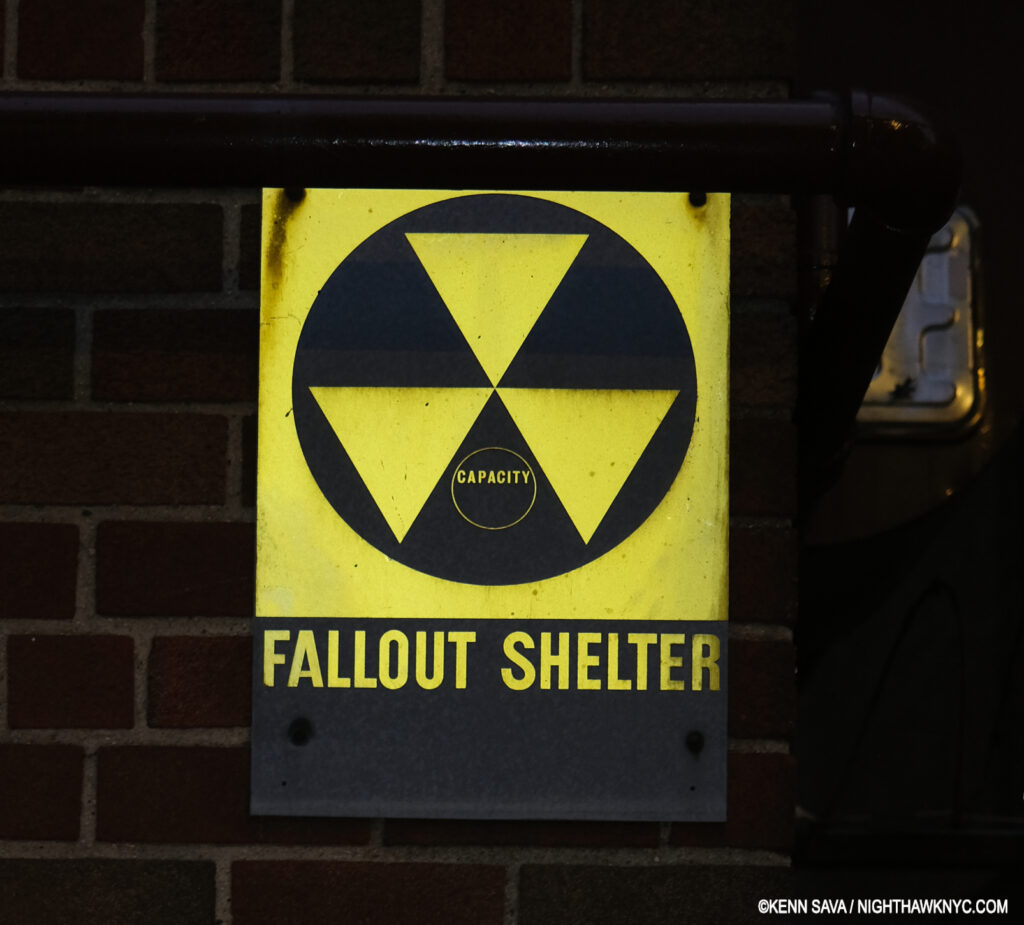 A glow-in-the-dark FALLOUT SHELTER sign around the corner from me seen at night in November, 2023. After as long as it’s probably been there, I sure hope I never need it.[/caption]