Lisa Yuskavage’s Flesh Studio

This site is Free & Ad-Free!
If you find this piece worthwhile, please donate via PayPal to support it & independent Art writing.
Other ways to support it at the end. Thank you!

Written & Photographed by Kenn Sava (*- unless otherwise credited).

Show seen- Lisa Yuskavage @ Zwirner.

Like many others, I’ve been enthralled watching Lisa Yuskavage’s star rise from her struggle to find an audience here in 1990 for her earliest work1, to finding acceptance in L.A. in the mid 90s which has continued to build since. All the while the Artist has held on to, grown & expanded, the signature mystery in her work.

“I was told no so many times by people that I kind of just forged a path. And I do think that it is incumbent upon an artist to forge their own path. And if people are saying you’re wrong and you feel very strongly about it, you’re probably on the right track. And then you’re clearing the way for other people,” Lisa Yuskavage2.
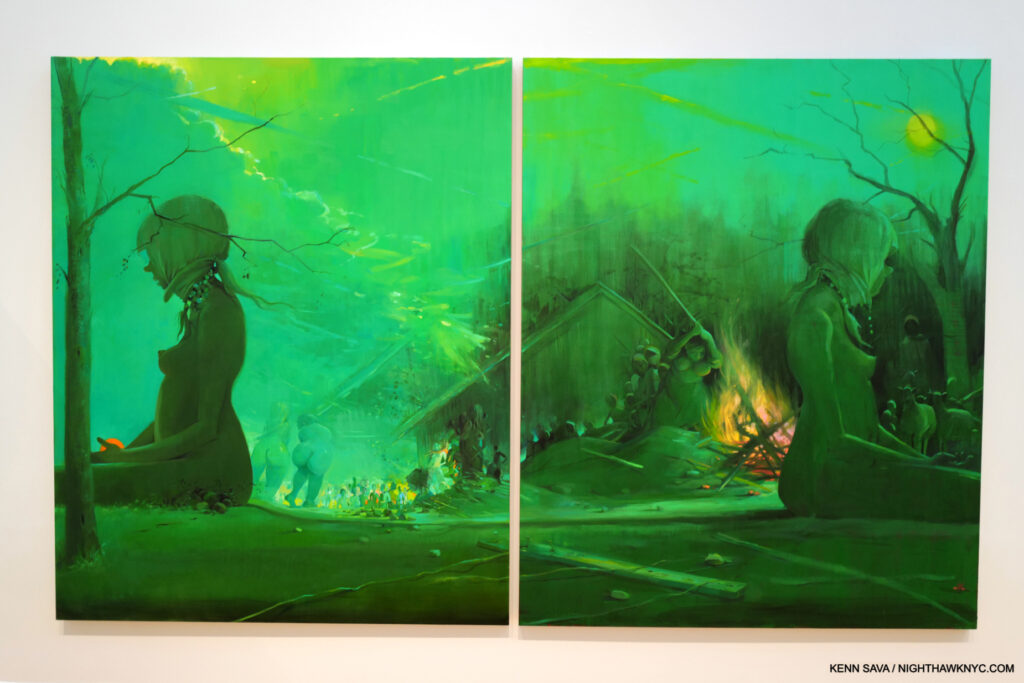
Bonfire, 2013-15, Oil on linen, a part of The Metropolitan Museum of Art’s Permanent Collection since 2015. Seen there on August 12, 2022.

Today, her Art is increasingly seen on museum walls around the world, both in permanent collections, and in their exhibitions. That’s a good thing, because it seems to me that Lisa Yuskavage’s Paintings need to be seen in the flesh. In person, be it from their sheer physicality of size (large or small), their light & color, or the mystery of their content, they tend to swallow up whatever space they’re in, as was the case in Lisa Yuskavage, her latest show at Zwirner, in both the smaller square side gallery, or the expansive open spaces of the rest of the show.
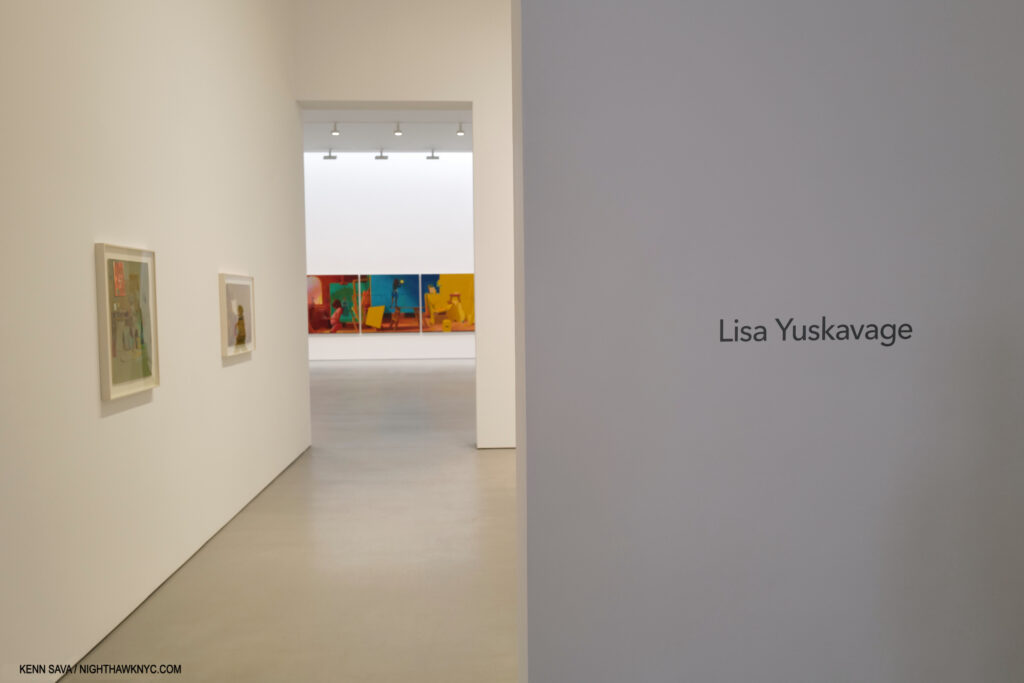
Lisa Yuskavage builds on her prior exhibitions this decade, which have become more and more centered on the Art & craft of Painting and being an Artist filtered through the prism of her 4 decades of Painting. Here, she looks back to Art School in two series titled Classes in Color Theory- Morning and Night. They, and most of the rest of the show, are set in a studio, or as she calls them “imagined spaces of creativity3,” the effect being the viewer is left feeling like a fly on the its unseen back wall. Canvases and frames are piled everywhere in these Paintings, forming geometrically interesting and intricate shapes which enclose the figures or the whole scene, adding a bit of abstraction to her compositions. Like this one-
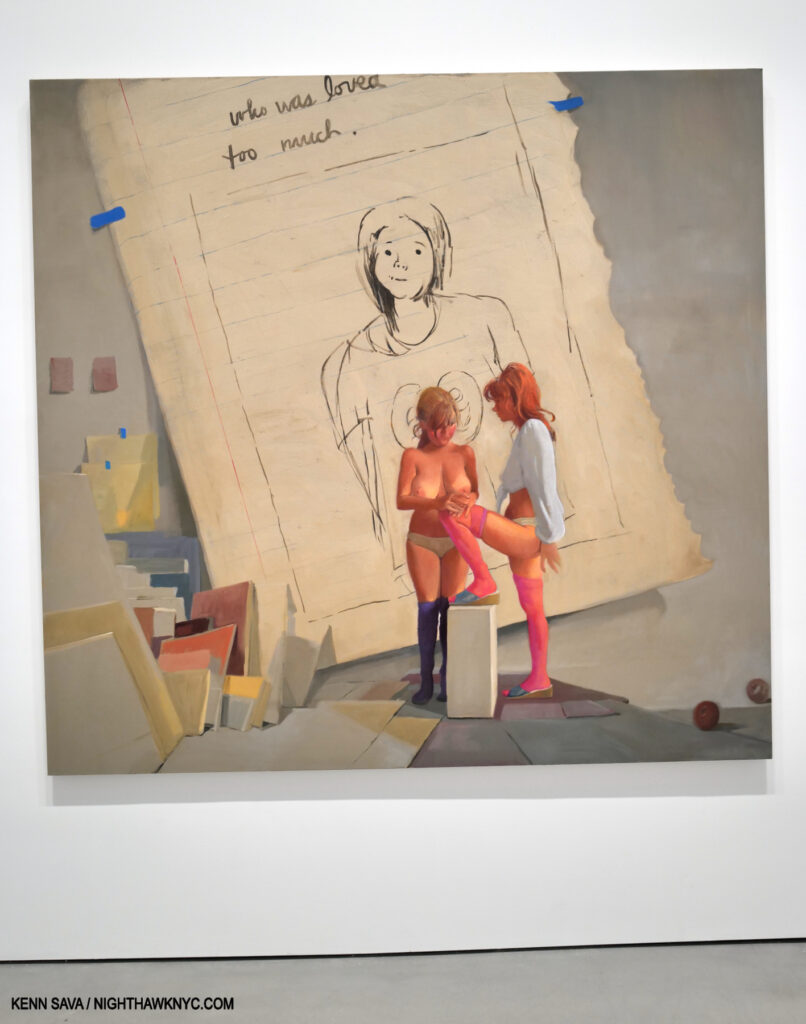
Notebook (Loved), 2024 All works are Oil on linen unless noted, 76 x 80 inches, the largest work in the room. Things are “off kilter” here in a few different ways.

This feeling of being “in the room where it happens,” as Lin-Manuel Miranda put it, begins with four works installed in a smaller square gallery to the left of the main spaces. Here the mysteries begin in the large Notebook (Loved), 2024, and three related smaller works. All four show two standing women, one with her hands on the other’s raised left leg in front of the huge titular notebook page with “who was loved too much” written on top over a Portrait. These two ladies appear in the other three works, these seem to be the only times two figures touch in this show. Canvases surround the pair in three of the four works revealing the studio setting. The fourth and most recent work, Loved, 2025, omits the notebook page, but includes a third woman in the foreground a bit in front of the other two. I found the original 1989 source notebook page on Lisa’s website where her staff posted it here. It’s remarkable that thirty-five years later it surfaces in three of these four works. Here, the phrase has evolved from “a girl who was loved by her father too much,” in the sketch,  to “a girl who was loved too much,” in Notebook (1989), 2024, to  “who was loved too much,” in Notebook (Loved), 2024, then back to “a girl who was loved to much,” Loved, 2025. But, WHO “was loved too much?” The girl whose leg is being touched? Her hair looks different from the sketch. Even the installation adds to the mystery. For one thing, Ms. Yuskavage decided to show these works as a group, yet not include the original notebook page.
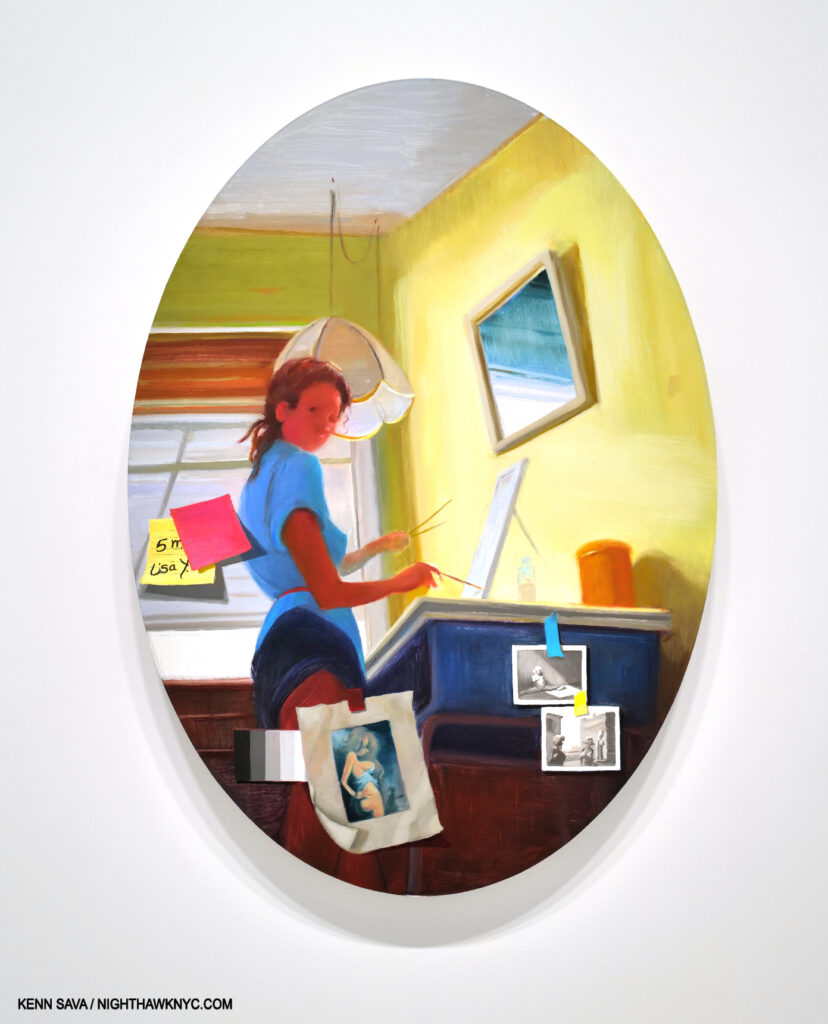
Painter Painting, Act I, 2026, 48 x 34 1/2 inches. Time is fluid in Lisa Yuskavage’s work. Characters from her earlier Paintings – here even the Artist herself from various points in her career, coexist in the world she’s created in her Art and in her recent work.

Moving into the rest of the show, which totaled 26 Paintings dated between 2022 and 2026, there are six in the series Night Classes in Color Theory, and one titled Morning Classes in New Haven: In the Department of Color Theory. Four have the word “Studio” in the title, four are Self-Portraits or de facto Self-Portraits (Painter Painting, Act 1, 2026, Easel Portrait, Painter Painting, and Self-Portrait: Red Yellow Blue), while an additional three show a Painter at work (Artist and Models, The Joy of Painting and Small Flesh Studio), and a fourth, The Demonstration, that possibly does, making eight possible Self-Portraits, about a third of the show.
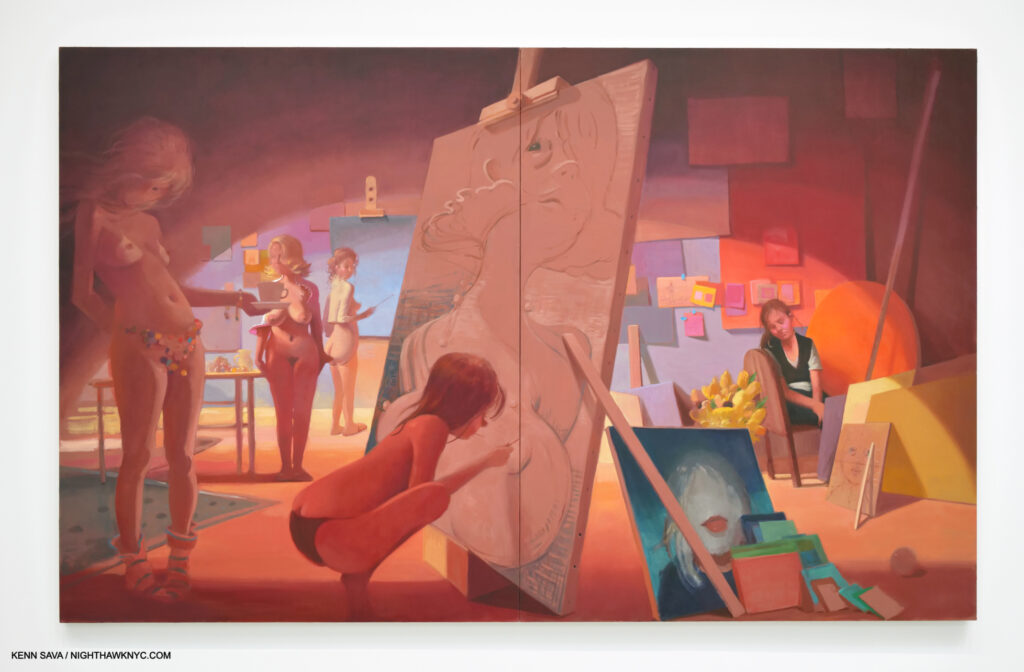
The Joy of Painting, 2025, Diptych, Overall: 80 x 128 1/4 inches

“For me, each character comes from a different moment. And some of them are invented, but I like the idea of having images of the person who made the work imagined within the work. And in some cases, this is well before any of this work was possible. So there are different paintings here where the image of the painter is from different periods in time,” Lisa Yuskavage4. 

To my eyes, only one of the 26 Paintings does not depict a primarily Art-related theme at first glance- On the Couch, though it does have two Paintings hanging on its back wall. Then again, the figure could be a model which would place her in yet another studio making what we are seeing what the Artist sees. Or, it could be (and is) a finished Painting of such. Still, the journey to becoming a Painter and the/her? daily life of a Painter, past & present, are at the core of her show, though her road to color mastery is a running subtext.

Peacock, 2024, 96 1/4 x 120 1/4 inches. Maybe it was the 90°+ summer heat outside, but this was the work that seared my brain and remains ingrained on it. For me, Peacock echoes Matisse’s The Red Studio (shown further below), before going its own way via the inclusion of the nude and the titular peacock. In many of these Paintings, a somewhat random wood beam seems to join sections together by leading the eye, as it does here, bringing the inner red room to the window with its own vibrant color, where the Peacock seems to sit between two worlds.

She must have aced those classes in color theory cum laude because former Art student Lisa is now one of the masters of color working today in my view. Yet, as with all things creative, there is learning & experience, and then there is innate talent. Though it has long stood out, I found her use of color & light in this show a tour de force, a masterclass, that overshadows the figures (no mean feat) to steal the show.

Detail of the upper center section of Night Classes in Color Theory, Lesson One: Green VII, 2026. It’s fun to ponder the colors that are, and are not, included.

“Well, color was always something that I just had a…it’s almost like just a kid sitting at a piano, and just kind of having an innate sense of playing,” Lisa Yuskavage5.
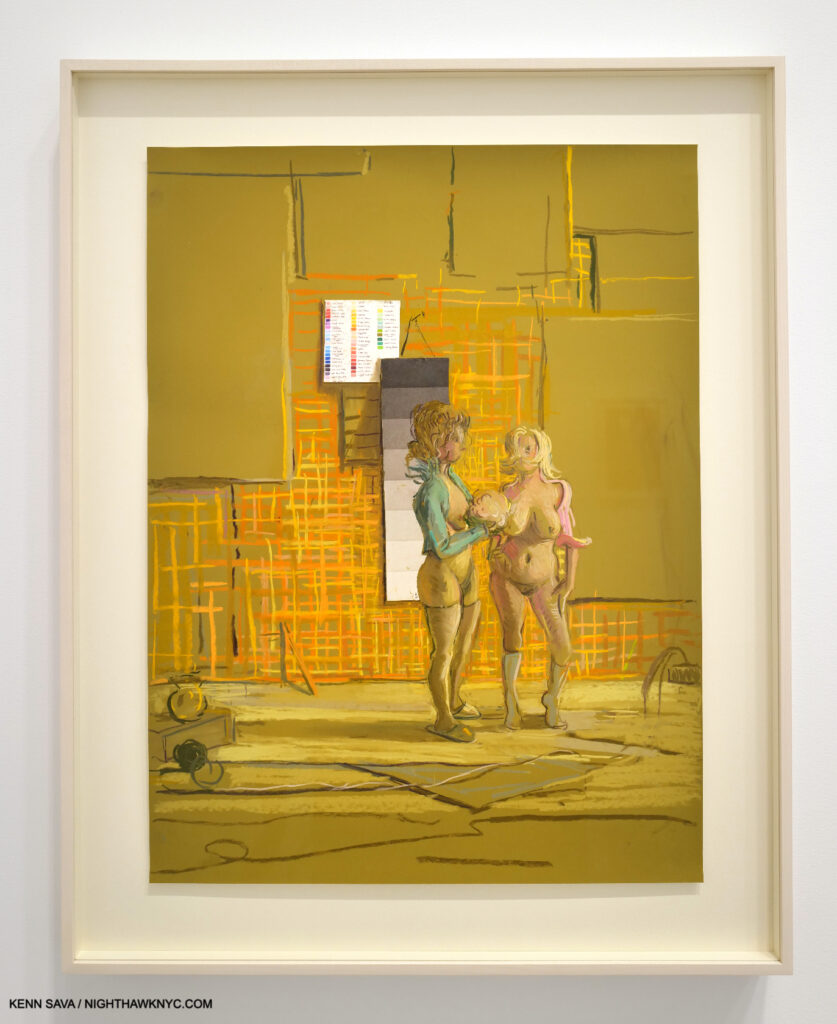
The full work,  Night Classes in Color Theory, Lesson One: Green VII, 2026, Pastel, gouache, and collage on Color-aid paper, 24 x 18 inches

Almost as ubiquitous as her palette her Paintings abound with something that has been standard fare of every museum for as long as there have been museums- nudes & partially draped women, though almost all of those have been created by men.
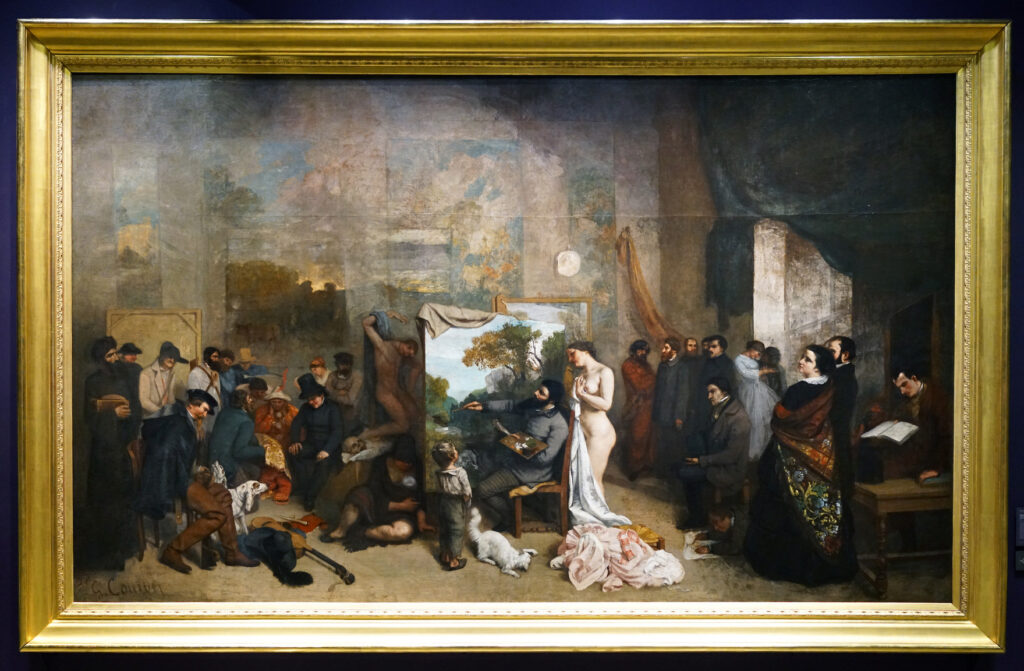
Gustave Courbet, The Painter’s Studio, 1854-5, Oil on canvas, 142 in × 235 in. *- Photographer unknown.

Yet, most of those men have not been nearly as criticized for the nudes in their Art as Lisa Yuskavage, an avowed feminist, has been6. Why can’t women Paint nudes if they want? It’s like some confuse the world Lisa Yuskavage has created in paint with our world and expect the same “rules” to apply.

“When you do anything like that, which goes [on] to become a shocking piece, you don’t know that you’re doing it in the first place. I’m not responsible for the shock. The spectator is responsible for the shock. He made the shocking thing by declaring it was shocking,” Marcel Duchamp, a Yuskavage influence, on this work– a nude, I recently wrote about that was deemed shocking when it was first shown7.

Here, most of these are standing, a few are squatting, two are lying, with one giving the viewer the finger, letting us know our gaze is not without consequences- as if Paintings could “fight back”-
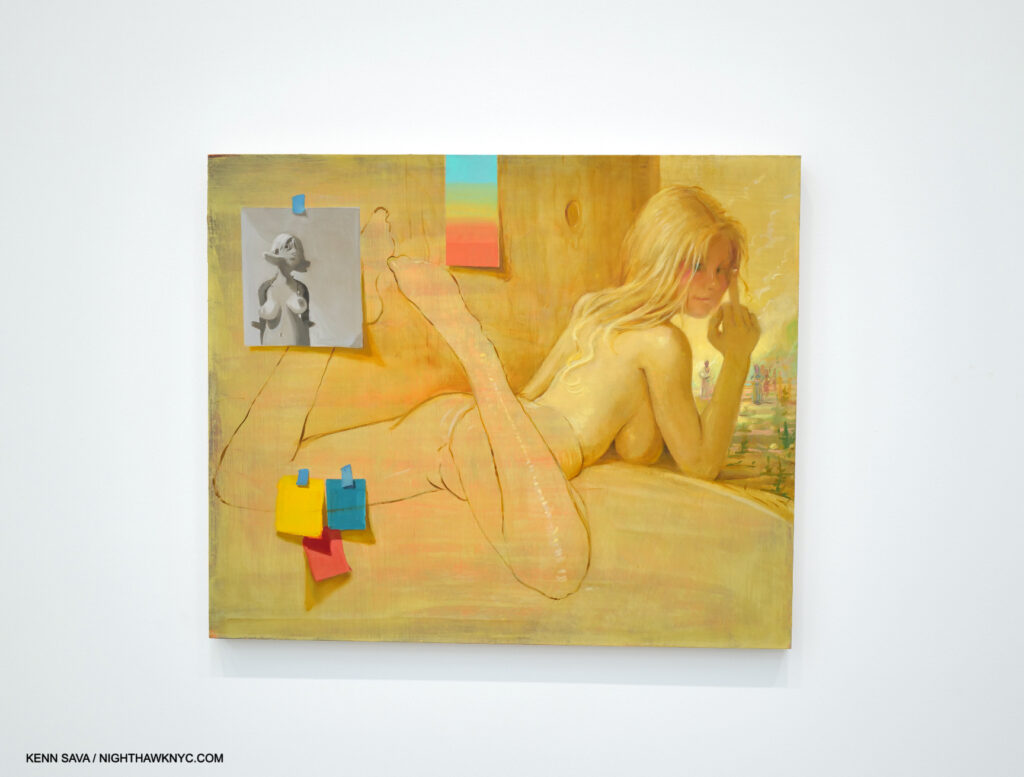
Legend: Red Yellow Blue, 2024-2025, Oil on linen, 25 1/8 x 30 1/8 inches

“I had this realization that…what if paintings had feelings? What if they were like not inanimate objects but had persona in the sense of the way, you know, um, Greek myths, everything is personified? You know, how does it feel when I’m making it? How does it respond to me and how does it respond to the audience?,” Lisa Yuskavage8.
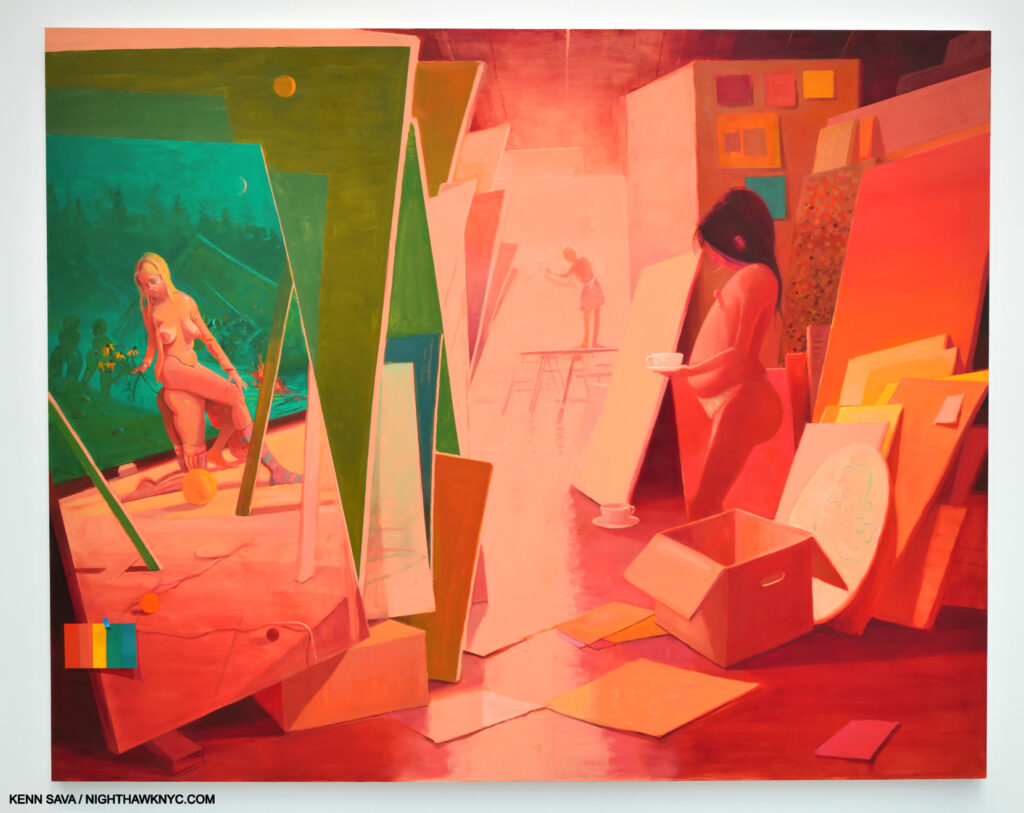
Gigantic Studio, Act II, 2026, Oil on linen, 96 x 120 inches

It seems to me the more I look at Lisa Yuskavage’s Art, the less I care that they are nude or partially clothed. The figures are so free, interesting, startling, and inspired, there’s much more to focus on than their lack of attire. Their pose or posture, for instance, how they interact with the other subjects, if any, and where have we seen them before in Lisa’s work- always a fun game that gets more challenging as the years go by. Yet even given they are all that, and more, it remains that spectacular light & color that wowed me more- and kept wowing me. Your results may differ.
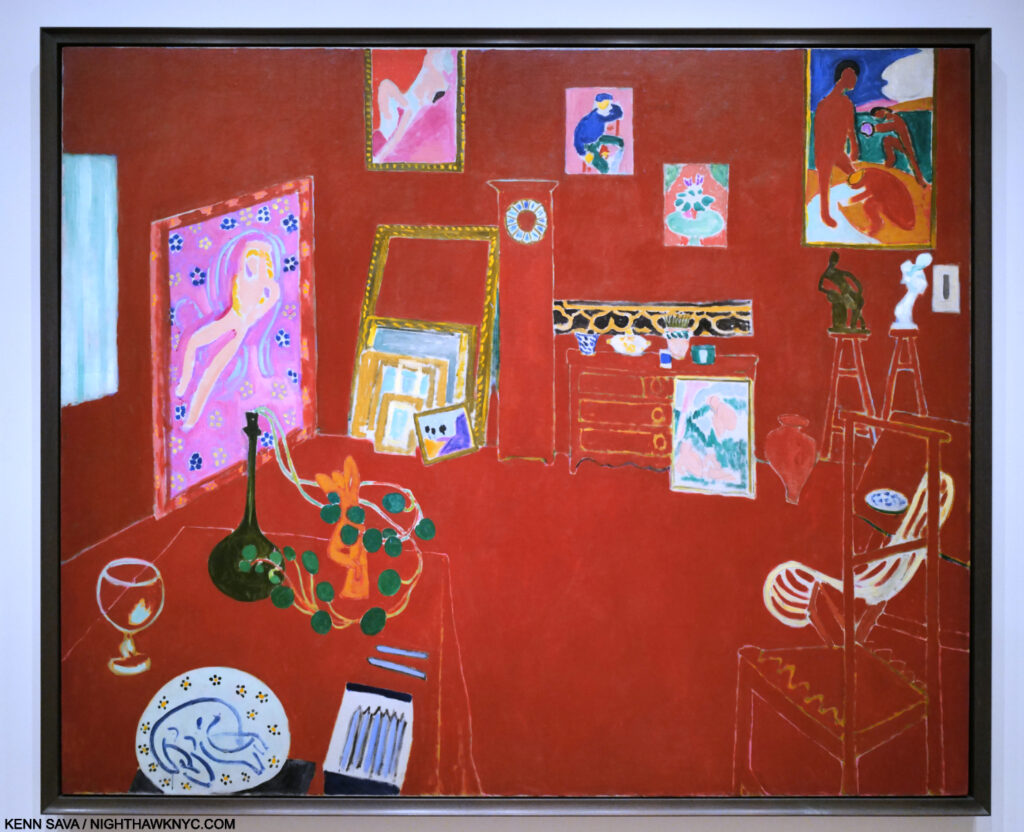
Matisse, The Red Studio, 1911, Oil on canvas, 71 1/4″ x 7′ 2 1/4.”

Her light & color does what her nudes do- they break down walls, give permission to break boundaries, open doors for further exploration, as well as disorienting the viewer. “Where, exactly, are we?,” may be something many wonder looking at Lisa Yuskavage’s work. The spaces look like any room, but the light & color make them other-worldly. It’s gorgeous and fascinating to the point that it overwhelmed my experience of looking at the work in this show. The effect might have been a bit like seeing a show consisting of works like Matisse’s The Red Studio, installed 30 blocks north in MoMA, in different colors. (The word “studio” in The Red Studio puzzles me. There’s no easel or apparent Painting in progress. It looks more like a collection of Art, possibly in a collector’s space, if not for the tray of crayons/pencils/oil sticks in the center foreground. I can’t help but wonder if that is a window partially seen to the far left, which might be echoed in Lisa Yuskavage’s Peacock.) In Artists and Models, 2025, On the Couch, 2025, Gigantic Studio, Act II, 2026, Peacock, 2024, Small Flesh Studio, 2022, Painter Painting, 2024, Self-Portrait: Red Yellow Blue, 2025, the light is red. In Morning Classes in New Haven: In the Department of Color Theory, 2024 and Legend: Red Yellow Blue, 2024-5, yellow. In Endless Studio (portal), 2025, the light is red in the left panel, and yellow on the right. Elsewhere, earth tones set the stage.
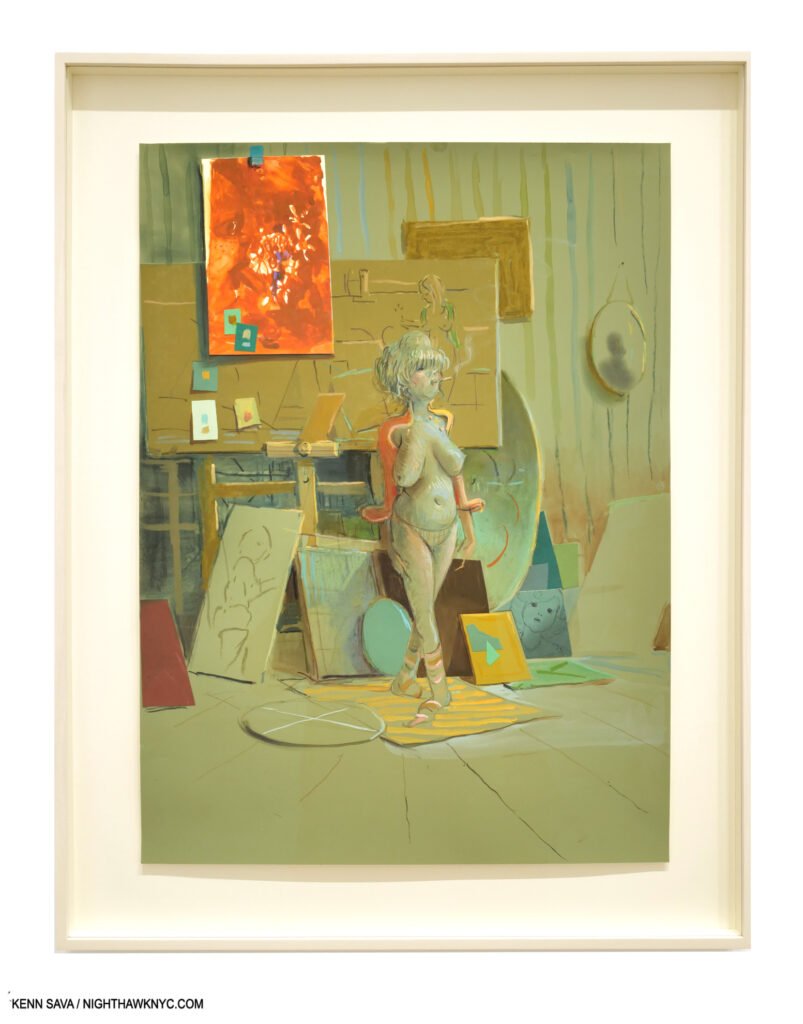
Night Classes in Color Theory, Lesson One: Green V, 2026, Pastel, gouache, and collage on Color-aid paper, 24 x 18 inches

Another element about her use of color that quickly becomes apparent is how she “features” or brings out certain colors in her Paintings. In Night Classes In Color Theory, Lesson One: Green V, 2026, that in spite of the title, the entire piece, largely a muted olive green including a semi-nude Painter, is upstaged by a rectangular picture-on-picture in reds to the upper left.

“And if you can look really closely, you can see the scraped down underpainting on every painting. It’s a different color field that then everything gets painted around. So it’s usually the color that’s pushing forward the most that is the ground color. … The earliest thing becomes the most pronounced thing in the foreground. And you know this little moment where the painted is also the painter, right? The subject is the object. The object is a subject,” Lisa Yuskavage9
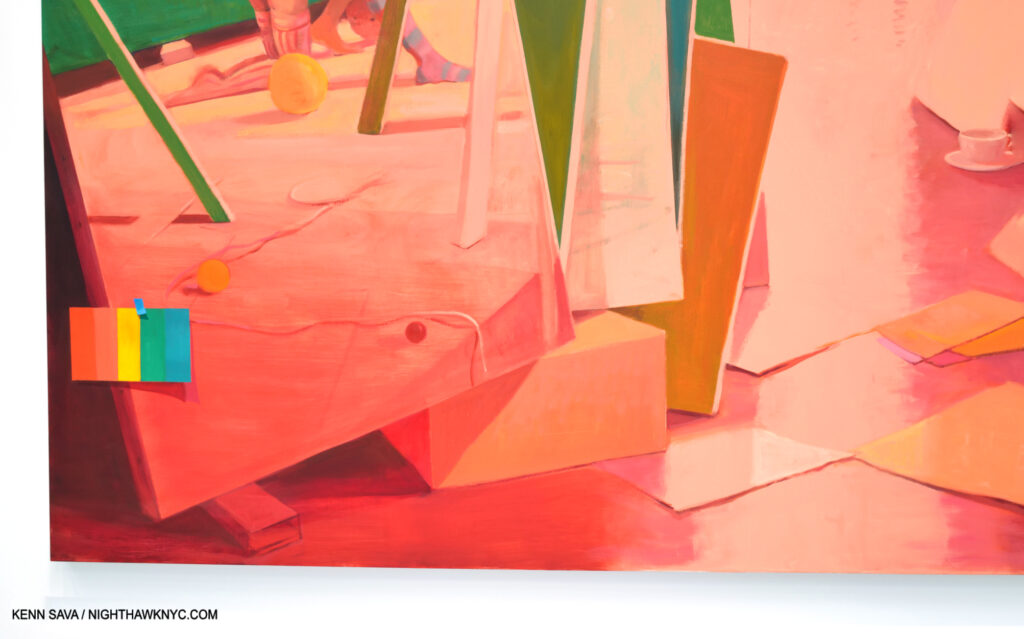
Detail of Gigantic Studio, Act II, 2026, Oil on linen, 96 x 120 inches

Then, virtually everywhere you look she shows off her unique way with shadows.

“…there’s a relationship between light and shadow and color. And it’s almost like in music. And I remember thinking, ‘I want to live in a world where shadows are gorgeous.’ A shadow can be anything, it can be pale yellow, as long as the light is lighter,” Lisa Yuskavage10.

It makes so much sense, yet I can’t say I’ve ever heard it said before. It also works perfectly here. As for Music, the colors at times border on the symphonic, though closer to the intimacy of chamber music.
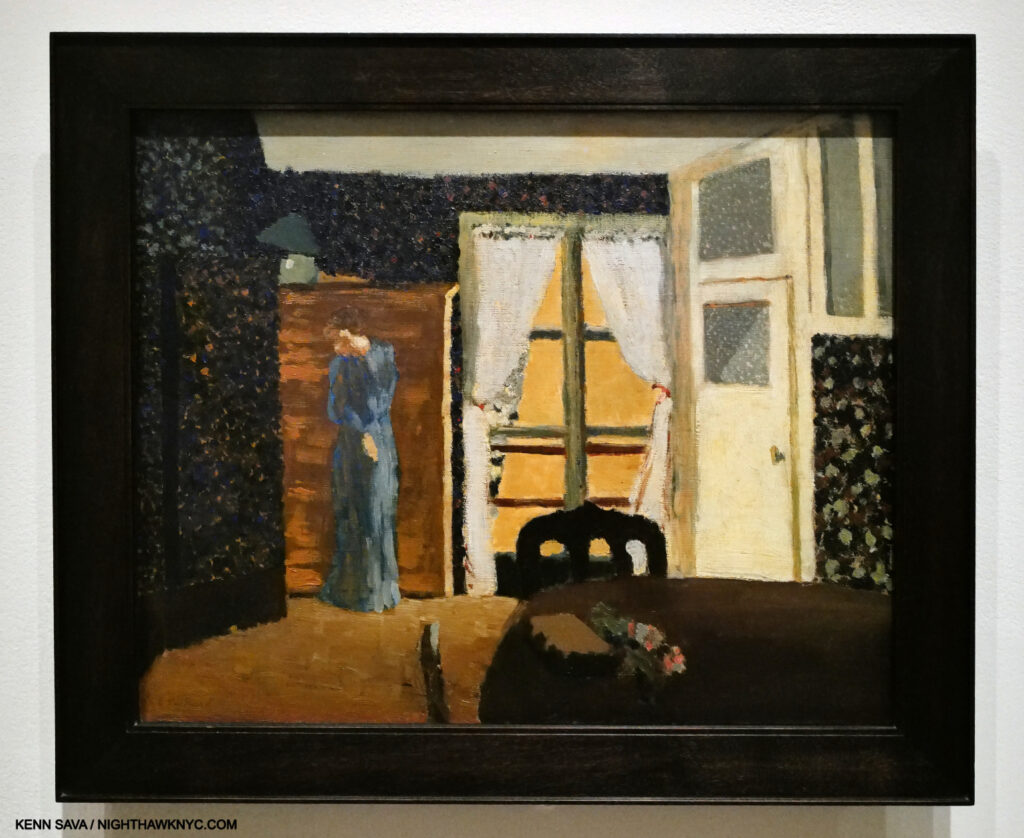
Edouard Vuillard, The Window, 1894, Oil on canvas. A Lisa Yuskavage influence, another master of interior color. Interesting use, and non-use, of shadows.

Night Classes in Color Theory, Lesson One: Green II, 2025, brings back the two women in the Notebook series (with the oversized Notebook page once again looming behind them), reprising a favorite device in her work: bringing back “characters” and elements from prior works. These references range from all over the Artist’s now thirty-six year career. In that time, she’s created her own “language” through them, and her own world. It’s a world that at once “flies in the face of feminism and modernism,” from an Artist who says, “of course, I’m a feminist11,” taking to task the two things that are at the core of her being: being a woman, and being an Artist who loves Art history. Giorgione, Bellini, Vuillard, Matisse, Morandi, Duchamp and, perhaps especially, Philip Guston, are Artists who’ve had a material effect on the Artist’s career & evolution. That’s quite a range of periods and styles. Yet of all the Painters working today, her work reminds me of her Zwirner stablemate Neo Rauch’s, as strange as that may seem, Both create worlds that look hauntingly like ours, yet always with twists, and always with impenetrable mystery. Both “abstract” their figures in ways unique to themselves. Maybe it’s because both bodies of work come from worlds I’ll never know- Neo Rauch’s dreams and Lisa Yuskavage’s life & experiences as a woman Artist. Incongruous maybe, but it keeps coming back to me.
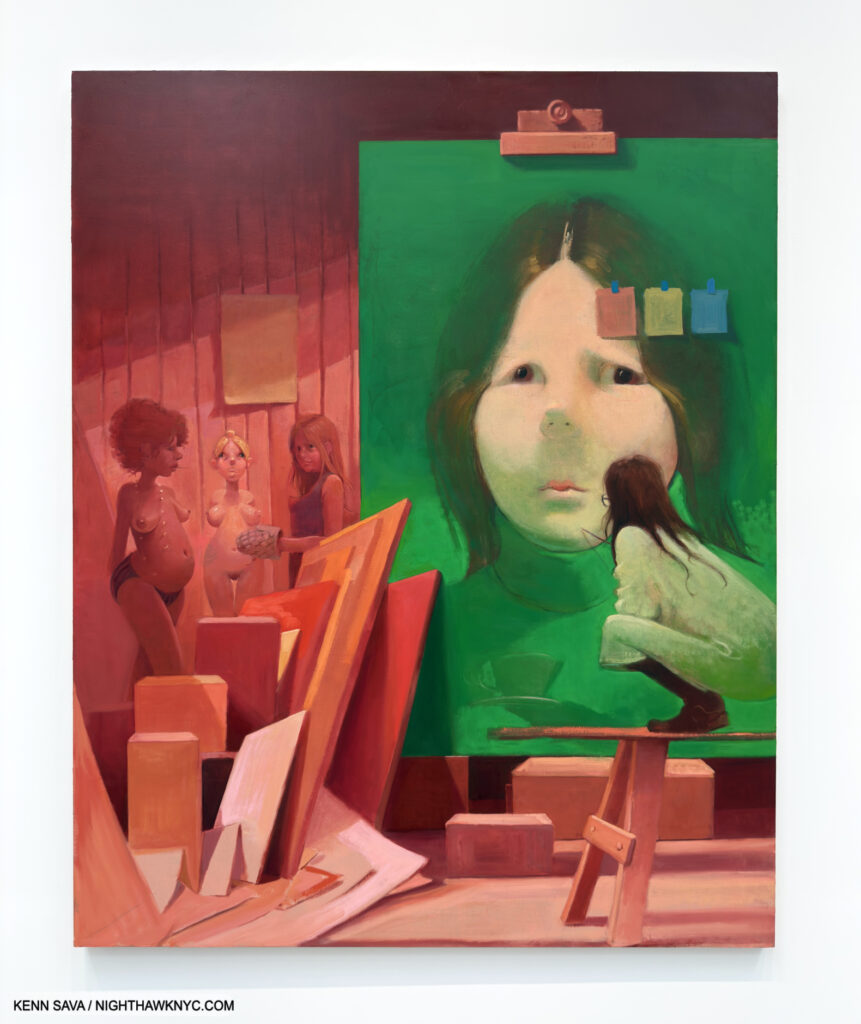
Self Portrait: Red Yellow Blue, 2025, Oil on linen, 80 x 64 1/8 inches

“I know my place.
I know my place, and this is it,” Olivia Rodrigo *

As I recently wrote in my piece about it, 114 years is more than enough time for the shock of Marcel Duchamp’s Nude Descending the Staircase, No. 2, 1912, to have yielded to the appreciation of the work for what it is. The same is true for Lisa Yuskavage’s work 35 years into her career.

*- Soundtrack for this piece is “all-american bitch” by Olivia Rodrigo from GUTS, 2023. Of it, Olivia said, “All-American it’s one of my favorite songs I’ve ever written and I really love the lyrics and I think it it expresses something that I’ve been trying to express since I was like 15 years old, this sort of repressed you know anger and and feeling like being put into a box as a girl.” She performs it here with her terrific band live in rehearsal-

NighthawkNYC.com has been entirely self-funded & ad-free since 2015! If you’ve found it worthwhile, PLEASE donate securely by PayPal below to allow me to continue. Thank you, Kenn.

You can also support it by buying Art, Art books & Music from my collection!
Art & Books may be found here. Music here and here.

Written & photographed by Kenn Sava for nighthawknyc.com unless otherwise credited. To send comments, thoughts, feedback or propositions click here. Click the white box on the upper right for the archives or to search them. Subscribe to be notified of new pieces below. Your information will be used for no other purpose.

  1. at Pamela Auchincloss Gallery, considered the first show of her mature work. ↩
  2. “Lisa Yuskavage on David Lynch, Giovanni Bellini, becoming an artist, and more – UNDER THE INFLUENCE,” Zwirner video. ↩
  3. “The thing about this painting is the studio or more accurately this imagined space of creativity is maybe potentially, you know, not a real space but an imagined space because there’s elements in here that have happened over various different moments of creation.” “Lisa Yuskavage Interview,” 2026, Zwirner. ↩
  4. Ibid. ↩
  5. “Lisa Yuskavage: PROGRAM,” Zwirner video. ↩
  6. ” In the Studio – Lisa Yuskavage”,  Zwirner video. ↩
  7. MoMA Audio Guide for their Marcel Duchamp blockbuster, which was up simultaneously. ↩
  8. “In the Studio – Lisa Yuskavage,” Zwirner video. ↩
  9. “Lisa Yuskavage Interview,” 2026, Zwirner. ↩
  10. Ibid. ↩
  11. “…of course, I’m a feminist, you know?,” In the Studio Lisa Yuskavage Zwirner. ↩

Marcel Duchamp’s Nude, Ascending

This site is Free & Ad-Free!
If you find this piece worthwhile, please donate via PayPal to support it & independent Art writing.
Other ways to support it at the end. Thank you!

Written & Photographed by Kenn Sava (*- unless otherwise credited)

Show seen: Marcel Duchamp at MoMA

LHOOQ, or LOOK, or “She has a hot ass” on a Mona Lisa Postcard.

With all the attention on everything that came later in Marcel Duchamp’s long career, like the mustachioed Mona Lisa postcard, L.H.O.O.Q., 1919, above, the Bicycle Wheel, 1913, among many others, it’s all too easy to forget that Duchamp (1887-1968) started out as a Painter. So, it was the very rare chance to see the overview of his Paintings included in MoMA’s Marcel Duchamp, the first U.S. Retrospective show of the Artist in 50 years, that most intrigued me.

The entrance lobby. Press Previews are too early for me, so I have to wait a long time to get these shots during normal hours. When I finally get one like this, it feels like the show is open just for me. Or you. Anonymous Photographer, Broadway Photoshop, NY, Multiple Portrait of Marcel Duchamp, 1917 surrounds The Chess Game, 1910, center. Marcel Duchamp would “retire” (sort of) from Art to focus on chess, his other obsession, later in his career.

With 300 pieces spanning his 68-year career far more than Paintings were on view in one of the largest shows I’ve ever seen. After an opening gallery of early Paintings & Drawings from 1900-10 that saw the Artist “trying on” styles borrowed from Degas, Gauguin, Cézanne and others, in 1911 he embarked on something his own. In only the 2nd of 9 galleries, 3 works on its last wall  stopped me in my tracks.

Out of the darkness, a wall with three Paintings that grabbed me and haven’t let go. Nude (Sketch), Sad Young Man in a Train, 1911 (Dated 1912), left, Nude Descending the Staircase, (No. 2), 1912, center, (No. 1), 1911, right. A copy of the very comprehensive Exhibition Catalogue lies on the bench.

I became obsessed with one Painting and one question, that ran incessantly through my mind over what would be 5 visits to the show, a number that would have been doubled had I not been limited by health issues-

HOW did Duchamp come up with this?-

Nude Descending a Staircase, (No. 2), 1912, Oil on canvas.

As far as I know, t’s unprecedented in Art history to 1912, and remains singular since. The only three Paintings Duchamp did in this style I know of are on that wall. Brilliantly executed, with exquisitely controlled chaos, I’d never seen anything like Nude Descending a Staircase, (No. 2). Well, except when I saw it twice before- the first time in 2005 in the Philadelphia Museum of Art, who own it, and then in 2013 in the 100th Anniversary recreation of the legendary 1913 Armory Show, which introduced it to U.S. audiences in NYC & Chicago, at the NY Historical. 13 years ago is enough distance for it to leave a fresh impression. Seeing it now in the context of his Paintings up to 1912, and the only two other works in this style, floored me. The jump between what he had been doing and this is a giant leap. It left me feeling it was, at once, a gambit raising the stakes on the Cubists, and again, one of the boldest declarations that “I have arrived!” in Art history and certainly in Modern Art history. Marcel Duchamp was 26 when he Painted it. After being rejected for inclusion in a show in Paris because he was asked to, and refused to, change its title, he allowed it to be shown at The Armory Show in 1913 where it was sold for $324.00 ($240.00 after commission).

J. F. Griswold, The Rude Descending the Staircase, Cartoon by J. F. Griswold in The New York
Evening Sun, March 20, 1913.

Being sold was one thing. The scandal its showing created was another. “An explosion in a shingle factory,” The New York Times review called it in their review of The Armory Show . Duchamp got a chuckle out of that, but WHERE was the appreciation for what he had accomplished here?

Thelma Cudlipp, The Nude Descending the Stairs,  Cartoon in The Sun, April 20, 1913

No one at the time seemed to appreciate it. It’s been slow in coming since.

Consider what he was up against. In 1911, Vincent van Gogh’s star was finally rising (after his death in 1890) on the heels of the largest ever (to that point) retrospective of his work at the Stedelijk Museum, Amsterdam, in 1905. Monet was busy making breakthroughs in his gardens in Giverny. Cézanne had only been dead for 5 years, his accomplishments still being absorbed, and Edgar Degas would live for 6 more years. Kandinsky finished Composition V in 1911, the first completed work in his legendary Compositions series, while Hilma af Klint toiled in obscurity mid-way towards completing her Paintings for the Temple series, 1906-15. Meanwhile, the Cubism of Picasso, Brague & Juan Gris was at its peak, and Umberto Boccioni and the so-called Futurists were obsessed with observing the modern world. Against ALL of this, Marcel Duchamp steered his own course, playing his Art “chess pieces” somewhere else, into an unoccupied space. It seems to me that he did exactly this with his work his entire career.

Checkmate.

The mechanics of movement. Detail of Nude Descending, (No. 2) of the lower middle section shows some of the ways in which Duchamp depicts movement, including the semi-circular lines to the dots in a circle, which Duchamp borrowed and was in turn borrowed by Francis Bacon. Note the functions of the black lines.

It’s very interesting that the stated materials for Nude Descending are only oil on canvas- no mention of graphite or another medium for an underdrawing. Since there’s no mention of an x-ray or any other “beneath the surface” exam on the wall card, in the exhibition catalogue or on the Philadelphia Museum of Art website, I’m left to wonder if the “underdrawing” is really the black lines all over the work. They’re exact, though purposely open-ended, helping to create the movement of the figures while outlining shapes. Still, if there is no underdrawing, it’s remarkable how well the complex composition fits on the canvas. The jarring fluidity of the figures is echoed in the staircase, the most unique set of stairs I’ve ever seen. They seem to be more Cubist than the figures. Towards the front, we see the side and the top straight on. Must be hard to walk down!

The palette brightens the standard Cubist fare somewhat, especially when seen next to Nude Descending No. 1, which was displayed here to the right of No. 2. That means visitors proceeding through the show chronologically (i.e. from left to right in my picture of the wall) saw No. 2 before No. 11), and the even more cryptic, Nude (Sketch), Sad Young Man in a Train, 1911 (Dated 1912), installed to the left of No. 2. For me, No. 2’s palette, which is somewhat lighter than many Cubist Paintings, emphasizes the “statement” Duchamp may have been making here that he had fully arrived as a Painter. Regarding the title, Duchamp said it was an example of “the use of words as a means of adding color… of adding to the number of colors in a work2.” At least one Drawing, Once More to this Star, 1911, does precede Nude Descending (No. 1), but it seems to have little to do with the series beyond showing a figure on a staircase, though going up and facing the other way. I have not come across any others. 

Cubism is static, revealing multiple sides of the same still person or object. In 1911, Duchamp set out to bring movement to Painting. In Nude Descending the Staircase (No. 2), he succeeded masterfully, one-upping the Cubists at their own game, creating something new, something entirely his own. Voices from all of the “isms” of the time rejected it. Of course they did. Marcel Duchamp was eternally beyond category.

Checkmate.

“I wanted to get away from the physical aspect of painting. I was much more interested in recreating ideas in painting.” Quoted on MoMA’s Introductory Wall Card to gallery 2.

In pondering Duchamp’s road to the Nude Descending, on the preceding walls of gallery 2 there were hints. One day, he watched a woman walking her dog, but didn’t speak to her.

Portrait (Dulcinea), 1911

This episode resulted in Portrait (Dulcinea), 1911. Unlike Dulcinea in Don Quixote, this one was real. A bit like Dante & Beatrice Portinari, the repercussions of this encounter would be enduring in his Art. Here, we see the same woman 5 times, a definite precursor to the Nude Descendings. Seeing someone multiple times is a characteristic of Film which exposes multiple emulsive frames each second.

“In 1912 … the idea of describing the movement of a nude coming downstairs while still retaining static visual means to do this, particularly interested me. The fact that I had seen chronophotographs of fencers in action and horse galloping (what we today call stroboscopic photography) gave me the idea for the Nude. It doesn’t mean that I copied these photographs. The Futurists were also interested in somewhat the same idea, though I was never a Futurist. And of course the motion picture with its cinematic techniques was developing then too. The whole idea of movement, of speed, was in the air3.”

Eadweard Muybridge’s Woman Walking Downstairs, 1887, which I edited, then reversed to mimic the direction of the figure in the Painting, while making an assumption, as I explain below.

Film was a relatively recent invention. In its early days, Eadweard Muybridge, who died in 1904, created ground-breaking movement studies, including Woman Walking Downstairs (a nude) in 1887.

I merged the 9 frames I selected in the Muybridge Film into one to see how closely it would resemble the Painting. Would Duchamp have able to do something like this in 1911 is unknown to me. Still,  it doesn’t come close to what we see in the Painting, especially in the legs. It seems to me that most of the development took place in Duchamp’s mind.

Nude (Sketch), Sad Young Man in a Train, 1911 (Dated 1912).

Given their dates, at MoMA the three Paintings were not arranged chronologically (Perhaps the curators decided to flank the larger Painting with the two smaller pieces for symmetry’s sake?). I’m looking at them out of chronological order, too. It’s the other Painting besides the two Nude Descendings on this wall that has also been the subject of much controversy. What, exactly, is being shown in Nude (Sketch), Sad Young Man in a Train, 1911 (Dated 1912)? The motion has led some scholars to suggest a masturbatory significance to it4. Others see Duchamp, himself, as the “sad young man”- the exhibition catalogue calls it a “Self-Portrait5.”  I haven’t been able to find any comment by the Artist on it, so its mystery remains intact, and most interesting for me as one of the few Paintings on the way to Nude Descending (No. 2) in a similar style. Like No. 2. It also includes multiple versions of the same figure, and what appears to be the main figure is brighter than the others. That hints at something else all three may have in common.

Nude Descending the Staircase (No. 1), 1911

According to the exhibition catalogue, Nude Descending (No. 1) is a “sketch” for No. 2, and (being dated 1911) was done before it, though it hangs after it in the show. Of it, the curators says, it “focuses on Duchamp’s aim of producing ‘a static representation of movement. A single upright figure, almost tentatively carrying out the action of the title, is represented in a few successive positions, rendered in a Cubist vocabulary of lines and planes of muted color6.” It also helps me see what may be going on in No. 2 a bit clearer. We can see the background more distinctly and the figure is somewhat more definite. It’s effective, but seen after No. 2, has nowhere near the same impact. For me, its primary value is as a stepping stone to a classic, allowing a bit of insight into how Duchamp developed his masterpiece. There is also a No. 3, however it’s a reproduction of No 2 that Duchamp hand-colored for one of his best clients, the Arensbergs, who were upset they were too slow on the trigger to acquire No. 2. It was not included in the show. 

My drawing mannequin walking down some imaginary stairs, nude…

The more I looked at Nude Descending (No. 2), I couldn’t help but feel the figure in it  looks somewhat like a drawing mannequin, particularly the top half of it. Somewhat. Drawing mannequins have been around for a very long time in one form or other, possibly for centuries. IF Duchamp had one, he could alter its pose to mimic a nude walking down stairs. He “could have.” I have no idea if he did.

A nude descending a staircase. *- LIFE Magazine Photo.

The other interesting thing about Nude Descending is that the commentary down through the century has assumed the figure is female. Yet, some believe the torso does not look female. “…the overall proportions of the figure and the treatment of the chest region suggest that it is, if anything, masculine. There is also the possibility of an effeminate male or a male in drag given the suggestion of a long skirt or dress and Duchamp’s later incarnation a Rrose Sélavy, his female alter ego photographed by Man Ray…7.” That reads like a contradiction to me.

My version of Nude Descending (No. 2) higlighting the right-most figure.

When I isolated what I believe to be the first figure in Nude Desending (No. 2 ), it looks more female to me than it does when considering the Painting as a whole, but not conclusively. I think it’s nebulous.

Marcel Duchamp descending a staircase. *- I believe this is a LIFE Magazine Photo, but I’m not sure.

The possibility that Nude (No. 2)  is another Self-Portrait can’t be ruled out. I have to say that though the above Photo was taken years/decades later- of, but not by Duchamp, there is a bit of resemblance to the Painting for me. At this point, all the evidence on the identity or the sex of the subject I’ve seen is inconclusive. What’s not is that it’s a brilliant Painting.

Marcel Duchamp discussing Nude Descending (No. 2) with Art historian Henri Marceau at the Armory Show 50th Anniversary Exhibition in 1963. *-  Smithsonian Photo.

“My aim was a static representation of movement, a static composition of indications of various positions taken by a form in movement—with no attempt to give cinema effects through painting. The reduction of a head in movement to a bare line seemed to me defensible8.”

His frustration with Nude Descending(No. 2)’s reception led to his giving up Painting, permanently! Before he did, on view in gallery 3, Duchamp created a few other important Paintings – in a completely different, yet equally remarkable style, including this one-

Bride, Oil on Canvas, 1912. I can’t help but think Duchamp’s good friend, Francis Picabia went to school on it in this amazing Painting from 1914, barely two years after Bride. Picabia, like his friend, wasn’t one to stay in one place (or one style) for long, as I showed in the piece about hime linked above.

It also stopped me and gave me much to think about. In Bride, 1912, Duchamp has taken Nude Descending one step further. Gone is the, apparent, physical movement of the figure/Bride, in its place it’s replaced by what’s taking place in the mind and state of being. This image would become the central image in his legendary work, The Bride Stripped Bare by Her Bachelors (Even), aka The Large Glass, 1915-23, which was not included in the MoMA show being permanently installed in the Philadelphia Museum of Art (where I saw it in 2005). As brilliant as Bride is, it’s apparently a study for The Large Glass. “The work can be viewed as ‘nature’ exposed or stripped bare by the scientific male gaze; this of course looks back to the voyeuristic theme of Dulcinea, but also, more importantly, anticipates The Large Glass as, literally, the Bride stripped bare by her Bachelors9 Marcel Duchamp or Rrose Sélavy, Box in a Valise. I counted at least 10 different Box in a Valises created between 1935 and 1941 in the show. It’s a bit ironic that Duchamp is the subject of a large museum Retrospective in NYC & Philly. He questioned the value of museums at one point, and created these as a “substitute.” Eventually, he came around and decided museums would be a good home for his oeuvre. He chose the Philadelphia Museum of Art. As part of his Boxes, Nude Descending (No. 2) got another life, as here where it is seen in a reproduction in the foldout left wing. He collaborated with the legendary Box genius, Joseph Cornell, on some of these.[/caption]

Thinking about the rest of the show, it seems to me that Marcel Duchamp spent his very long career bringing his favorite non-Art pastime, chess, to his work: he continually played chess with the Art world. He continually made gambits, moving his (Art) pieces where Art wasn’t. He also had serious questions regarding the viability of museums. Yet, he maintained a relationship with MoMA’s founding curator, Alfred Barr, who showed his work there early on, and MoMA helped Duchamp emigrate from Nazi Europe to the U.S. in 1941. Duchamp also guided his devoted collectors, Louise and Walter Arensberg  to leave their large collection to the Philadelphia Museum of Art in 1950, creating the world’s largest Duchamp holdings. It seems to me that in the end, Duchamp relaized museums were his best chance at maintaiing indefinite visibility. Marcel Duchamp at MoMA, and soon to open in Philadelphia, is proving him right.

As I walked through the rest of the show I couldn’t shake the sadness I felt that Duchamp, who’s Art career would continue for another FIFTY-SIX years after Nude (No.2), was no longer Painting.

“Symbolist traces may well have contributed to the unfavourable reception of Nude Descending a Staircase, (No.2) when Duchamp entered it for the Cubist-dominated Salon des Indépendants in March 1912. Albert Gleizes, a key figure in the Puteaux Cubist group and chairman of the hanging committee, asked Duchamp’s brothers to persuade him at least to change the title. Duchamp refused to do so and withdrew the picture. Although the work was shown in October of that year at the ‘Salon de la Section d’Or’ exhibition in Paris, and was later the succès de scandale at the International Exhibition of Modern Art, known as the Armory Show, in New York in 1913, Duchamp took the rejection badly10.”

“His lack of faith in the supposed open-mindedness of the self-appointed avant-garde, which manifested itself most obviously in the 1917 Fountain hoax (a porcelain urinal sent as an exhibit), can be dated from this event11.” Fed up with the reaction Nude Descending (No. 2) received, he turned his back on Painting, assumed another identity and created this in 1917-

Fountain, 1950 (replica, after lost 1917 original), Porcelain urinal

I don’t blame him.

As the 9 galleries of his work at MoMA showed, the world gained, perhaps, THE most influential Artist of the 20th century not named Picasso, but it lost what might have been one of its greatest Painting careers far too early.

“Watch yourself, skeleton, the museum will find you
all down the staircase, the first place you fell in love.” *

Special Thanks to Lana Hatten for research assistance. 

*- Soundtrack for this piece is “Stairs” by Joy Again from Forever, 2014.

NighthawkNYC.com has been entirely self-funded & ad-free since 2015! If you’ve found it worthwhile, PLEASE donate securely by PayPal below to allow me to continue. Thank you, Kenn.

You can also support it by buying Art, Art books & Music from my collection!
Art & Books may be found here. Music here and here.

Written & photographed by Kenn Sava for nighthawknyc.com unless otherwise credited. To send comments, thoughts, feedback or propositions click here. Click the white box on the upper right for the archives or to search them. Subscribe to be notified of new pieces below. Your information will be used for no other purpose.

  1. Had I been curating, I would have put Nude Descending (No. 1) first, (No. 2) in the middle, andNude (Sketch), Sad Young Man in a Train, 1911 (Dated 1912) on the right. ↩
  2. ibid, P.87 ↩
  3. Katherine Kuh, Marcel Duchamp, Interview broadast on the BBC, March 29, 1961. ↩
  4. Ashton, etc., World of Art: Marcel Duchamp, P.51 ↩
  5. Marcel Duchamp, MoMA, P.86 ↩
  6. ibid, p.86. ↩
  7. Ashton, etc., World of Art: Marcel Duchamp, P.56. ↩
  8. Peter Brooker, Andrew Thacker, Geographies of Modernism, 2005 ↩
  9. Ashton, etc., World of Art: Marcel Duchamp, P.70.”

    “But, the damage had been done. “Immediately I wanted to change. The idea was to change; not to repeat myself.” Quoted on a MoMA Wall Card.

    So, after painting a Mural to hang over a client’s bookcase, this incredibly gifted Painter would Paint no more. He turned his attention to, well, everything else. After the Bride Stripped Bare, he invented the Readymades, which have achieved legendary status and. become incalculably influential.

    [caption id=”attachment_33864″ align=”aligncenter” width=”849″ ↩

  10. World of Art: Marcel Duchamp, P. 56. ↩
  11. ibid. ↩