Ten Seconds With Alfred Schnittke

This site is Free & Ad-Free!
If you find this piece worthwhile, please donate via PayPal to support it & independent Art writing.
Other ways to support it at the end. Thank you!
 

Written & Photographed by Kenn Sava (*- unless otherwise credited).

How long does it take to sign your name? In 1988, I watched as one signature took longer than it might take you or me, and that’s kept me thinking about it ever since.

Modern & Contemporary Classical Music may not be among the most popular genres of Music, but that doesn’t mean it doesn’t include extraordinary people. Still, it’s quite a bit more popular today than it has been for most of my life. It’ll never be mainstream, but as I’ve sold off my Music collection these past 10 years to keep this site going, I’ve met a lot of its passionate fans, which is refreshing to see. One thing I won’t be selling is a yellowed, 38 year-old section of a Sunday New York Times signed for me by one of it’s most important figures.

A treasured possession for 38 years. My copy of  the May 22, 1988 New York Times Arts & Leisure section, signed for me by the late Alfred Schnittke, who was too engrossed in Composing to care about his tie.

Imagine meeting Beethoven, Brahms, or even J.S. Bach? Alfred Schnittke (1934-1998), who may have been the last 20th century Composer in that line that pre-dates Bach, is the closest I’ll come to meeting someone whose name can be, and most likely now has been, spoken in the same breath as theirs1. 

The first paragraph of the article to the left of the picture that is now signed, shown above. I also admire Cage, Ligeti and especially  Olivier Messiaen (1908-92).

Mr. Schnittke (1934-1998) was a German/Russian/then German again, 20th Century Composer, who created an extensive body of astonishing Orchestral work, Chamber Music, about 70 Film Scores, and an Opera.  

Alfred Schnittke, left, acknowledging an endless standing ovation after a performance of his Violin Concerto No. 4 with the great violinist, and Schnittke champion, Gidon Kremer, right. Screenshot. Location & date unknown. Such was the interest in this concert, the audience was shown completely filling all the aisles! That leads me to believe it was in the USSR.

Set the way-back machine for May 22, 1988. I was relatively new to his Music then (though I know enough 38 years later to realize that I’ve still only scratched the surface of it), but I was very taken with it the very first time I heard it. That Sunday, I read that one of his works, his Piano Sonata, was being premiered as part of an All-Schnittke concert at the Grace Rainey Rogers Auditorium of The Metropolitan Museum of Art in an article titled “An Eclectic Mix, Through a Contemporary Prism.” in that Sunday Times Arts & Leisure section. I called for tickets and went with a few adventurous friends.

Inside Grace Rainey Rogers Auditorium looking out from the stage. I’ve noted the approximate seating locations of Mr. Schnittke & myself that night in May, 1988. *- Metropolitan Museum Photo.

Our seats were in the balcony. During the 1st part of the concert, which was all Chamber Music (his Quasi una Sonata, 1968, for violin & piano, Piano Quintet, 1972-76, and the String Trio, 1985, were performed), I was surprised to notice the Composer, sitting by himself  right of center a few rows from the stage. He was a bit hard to miss, even from the back at a distance. Wearing a dark suit, he had distinctive long straight dark hair, not unlike that of George Harrison or Ringo Starr of The Beatles in the late 1960s, circa Abbey Road. Mr. Schnittke (who was considered a Musical “extremist” by the powers that be in the USSR) was someone who was always up to date on the latest in Music around the world. I’ve often wondered if his hairstyle of the time was a Beatle influence, especially with what we know now of their importance as a cultural force in ending the USSR. Nevertheless, his presence at this concert was something of a shock, as I’ll get into. The article didn’t mention he’d be here.

The hall had about half-emptied as the audience decamped to the lobby during the intermission between halves. Mr. Schnittke was still sitting alone. What I heard in the first half affirmed my initial feelings about his Music, so  I grabbed that Arts & Leisure section and a pen and decided to go down there. Gulp. Completely out of character for me at the time. Downstairs, the path down the aisle was relatively clear, leaving me to gather my nerve and my thoughts. Though it felt like an out of body experience, I remember thinking ummm…what was I going to say to him? I don’t speak Russian, and only a few words in German. “Gutte abend, Herr Schnnittke.” Then what? When I got to about 15 feet of his row, I suddenly realized I wasn’t as alone as I thought I was. Dark shapes were moving in behind me, and then around me. Men in black suits. Just before they reached me, I reached Mr. Schnittke’s row. 

Without saying a word, I reached in, extended my right hand and arm, holding The Times article with his Photo facing up, with a pen tucked into my thumb. The shapes around me seemed to stop. Luckily, Mr. Schnittke turned to his right, glanced up at me, saw my arm with the newspaper, and reached up and took it. No words had been said. He pulled it down, and signed it. With difficulty.

My heart sank. I had imposed on him, and felt terrible that this uniquely & incredibly gifted man was having such difficulty simply writing his name! I had walked down that aisle smack dab into the middle of something, and someone’s life, that I couldn’t even begin to imagine.

In the days, months, and 38 years that followed, I’ve learned much more. Alfred Schnittke had overcome more than most of us can imagine to be sitting in that seat in Grace Rainey Rogers Auditorium that evening.

Though his star continues to rise, this is the work that may yet make Alfred Schnittke a household name. His homage to times past in his gorgeous “Suite in the Old Style” performed here in its arrangement for Chamber Orchestra by the WDR Symphony Orchestra and Andris Poga on Jan. 15, 2021. Though an outlier compared to much of his Music, it reveals a mastery of what had come before, something he seamlessly assimilated into the rest of his work.

“To tell the truth, even though I was his friend, I did not know that he was capable of such careful and interesting analysis, that he had such a profound insight into the music of other composers, and that he found in it so many regular features that were hidden from others,” Mstislav Rostropovich 2

In 1985, just 3 years earlier, he suffered a stroke that left him clinically dead, more than once! Yet, he managed to recover and get back to composing, and one of the first pieces he finished, after 3 years of work on it, was the Piano Sonata (now known as Piano Sonata No 1) which received its World Premiere that night by Vladimir Feltsman, who had commissioned it, mere minutes after he signed my newspaper. It’s gone on to become part of the repertoire and has received a number of recordings. Seeing how hard it was for him to sign his name, I wondered how hard it must have been for him to write such complex Music at a time before the assistance of computer Music Composition software!

Hard enough as all of that must have been. There was much more.

Those men in black suits who had begun to surround me might have been KGB or some other security force whose job it was to make sure Mr. Schnittke didn’t escape and seek asylum. It tuned out that the Soviet Composer’s Union (who had previously banned his Symphony No. 1, 1969-74), had banned him from traveling outside of the USSR in 1980. So, being allowed to attend a foreign premiere of one of his pieces in 1988 must have been a recent development, making attending the Premiere of his Piano Sonata a new thing for him. Though it was a sign that things were changing for Soviet Composers, Musicians & Artists, those men in black reminded me the oppression he had lived & Composed under for decades wasn’t over. This was, most likely, his first visit to NYC. 

A glow-in-the-dark FALLOUT SHELTER sign around the corner from me seen at night in November, 2023. After as long as it’s probably been there, I sure hope I never need it.

Though I had read Solzhenitsyn’s Gulag Archipelago, I  knew nothing about the reality of life in the USSR for every day people, beyond what we imagined here in the U.S., during what was then still the Cold War. I knew that Shostakovich & Prokofiev had faced constant pressure to conform to State expectations, but little more. I can’t name a Soviet Painter from the Post-War generation after Malevich & Lissitzky. I lived through the Cuban Missile Crisis, which was DAMN scary for a little kid, taught to “duck & cover” under my school desk (never mind it was right next to a wall of 5 foot tall glass windows), as a means of “surviving” an atomic bomb. Even in 2026, I still spot rusted and faded “FALLOUT SHELTER” signs in my neighborhood and around town, an eerie reminder that the danger hasn’t completely gone away and there’s not much one can really do to “protect” her or hisself from it.

Ban this! A box set of the ten Symphonies Afred Schnittke managed to complete in spite of it all. Released by the European BIS label in 2009, it’s the first and only set of his Symphonies on record thus far. He didn’t live to complete his 9th Symphony, so the recording included here is a 2006 “construction.”

Dimitri Shostakovich died in 1975. I had no idea what the situation was for Composers, Artists & Musicians after him, until I began reading Alexander Ivashkin’s Schnittke biography, the only one done on him thus far. In addition to the intractable Soviet Composer’s Union (as if that wasn’t ENOUGH to deal with), Mr. Schnittke’s health continued to decline. 

Many of the leading Soviet Musicians of his time championed & commissioned work from Alfred Schnittkel, which enabled him to survive & continue. Here he is with two of them- the legendary cellist & conductor Mstislav Rostropovich, left, and the great violist Yuri Bashmet, right, circa 1988 or 1990. From a Schnittke/Bashmet/Rostropovich CD Booklet.

In 1990, less than two years after he signed my newspaper, he emigrated to Hamburg, Germany, where he taught and continued to Compose, but he suffered yet more stokes. His last stroke paralyzed his right side. He continued to compose, writing with his left. On August 3, 1998, he passed away at just 63, a little more than 10 years after my brief encounter with him.

One of the first CDs of Alfred Schnittke’s Music, recorded in the USSR, and released by a USSR record label in 1984 on LP then on CD in 1990. Especially after his Symphony No. 1 was banned, it’s absolutely amazing to me, and a testament to his passion & dedication, that Mr. Schnittke persevered and continued to create such daring and creative Music, AND got it heard, performed & recorded in the USSR!

Today, I see so much more when I look at that old newspaper. I see that NOTHING stopped Alfred Schnittke.
-Not having his Symphony No. 1 effectively banned by the Composer’s Union. He went on to Compose 9 more.
-Not being banned from traveling outside the USSR. Other Artists, including Gidon Kremer, Mstislav Rostropovich, Oleg Kagan, and Mark Lubotsky commissioned Music from him (which helped him survive), then performed it throughout the world. (His wife, the brilliant pianist Irina Schnittke, continued to champion, perform & record his work after his death.)
-Not the stroke he suffered in 1995, from which he “came back from the dead” to finish the Piano Sonata I heard premiered that night. The same night he persevered to sign my newspaper.
-Finally, not the subsequent strokes he suffered that didn’t stop him from Composing right to his death in 1998. Schnittke scholar Gerard McBurney feels that it is the works he Composed over this last decade (including his Fourth Quartet, 6th, 7th & 8th Symphonies) “that will ultimately be the most influential parts of Schnittke’s output 3.”

I came think that sitting alone in Grace Rainey Rogers that May night must have been a moment of sheer triumph for him.

Perhaps that taste of freedom was enough to convince him to finally emigrate to Hamburg, at last escaping the tyrannies of the USSR and the Composer’s Union.

With Princess Diana. *-Date, place & Photographer unknown. From gold.ac.uk

In spite of ALL of that, he left us an extraordinary amount of Music. As I write, Discogs lists 376 releases of his Music on LP or CD. IMDB lists him as a Composer on 79 Films. Among them are at least two that are considered classics- The Commissar, 1967, and Larisa Sheptiko’s final Film, The Ascent, 1977.  Those early years writing Film scores gave him fluency with an extremely wide range of Musical styles that formed the basis of his own Compositions. Film Composing also paid his bills until he could get his other Music heard.

“Each of us has the right to experiment,” Igor Stravinsky4

Alfred Schnittke’s Concerto Grosso No. 1 is, perhaps, more like most of his Music than Suite in the Old Style heard earlier. Performed live here by Gidon Kremer & Tatiana Gridenko, violins, the two Artists who premiered it in 1977, and the Kremerata Baltica in Moscow in 2004, on the 70th anniversary of Schnittke’s birth.

Alfred Schnittke’s Music is something of a logical conclusion to the Western Classical Tradition to this point. What I mean is that Mr. Schnittke was a voracious student of Music history- especially Contemporary Music history- he lectured & wrote about it. Now, it was hard in the West in the 1970s and 80s to hear cutting edge Contemporary Classical Music. There were few recordings, and it wasn’t played on the radio or performed in concerts all that often. To hear it in the USSR, where much of it was forbidden. was many fold more difficult. Still, Mr. Schnittke heard it and brought elements of it into his work. But he didn’t stop there. He invented a style which he called “Polystylism,” “which juxtaposed and combined music of various styles past and present5.” Of it he said-

‘”It is not just eclecticism for its own sake,” he explains. ”When I use elements of, say, Baroque music, I do it not simply because I want to juxtapose different styles, but because I feel it’s what I have to do in the piece at hand. Sometimes I’m tweaking the listener. And sometimes I’m thinking about earlier music as a beautiful way of writing that has disappeared and will never come back; and in that sense, it has a tragic feeling for me. I see no conflict in being both serious and comic in the same piece. In fact, I cannot have one without the other. They are two sides of the same consciousness,”‘ Mr. Schnittke says in the NY Times article he signed.

As a result, his Music has a way of summing up our times and what has come before.

Alfred Schnittke being allowed to come to NYC in May, 1988 might have been a sign that the USSR was about to end, which it did three and a half years later. Perhaps his perseverance & dedication played a small part in that in some way. That endless standing ovation after the aisle-filling Violin Concerto No. 4 performance I mentioned earlier, was an indication of how very popular Alfred Schnittke had become in the late days of the USSR.

”He is one of the greatest humanists who ever worked in the art of music,” former NY Philharmonic Music Director & conductor Kurt Masur said6.

How long does it take to write your name? For my part, I hope he was pleased that someone so far from home responded to it enough to approach him for his autograph. My entire encounter with Alfred Schnittke lasted maybe 10 seconds. On this yellowed page I see his determination to overcome everything life threw at him to leave the world the incredibly special gift of his unique Music. He also left us his example. Without saying a word to me, Mr. Schnittke has helped me gain strength to continue doing what I need to do, in spite of the difficulties, illnesses and ailments I’ve had to deal with (things everyone has to deal with).

Kenn Sava at the entrance to Grace Rainey Rogers Auditorium (which looks exactly as it did in May, 1988), at The Metropolitan Museum of Art, holding a copy of Alexander Ivashkin’s Alfred Schnittke biography, April 13, 2026. My thanks to the kind lady who took this.

This piece is my small way of paying Alfred Schnittke back, and paying him forward, for his kindness to a total stranger one night in May, 1988. I hope spending time getting to know him rewards you, too.  

*- Soundtrack for this piece is Alfred Schnittke’s “Suite in the Old Style,” heard above.

This piece is dedicated to Mirek Goraj, another survivor & the resident tech genius at the Aperture Foundation, for his undying support of NighthawkNYC, for getting the site migrated to a new host so all of you can read it for the next 4 years, for getting my computer up and running, and, especially, for his friendship that I can’t live without through thick and thin lo these past two decades. 

NighthawkNYC.com has been entirely self-funded & ad-free since 2015! If you’ve found it worthwhile, PLEASE donate securely by PayPal below to allow me to continue. Thank you, Kenn.

You can also support it by buying Art, Art books & Music from my collection!
Art & Books may be found here. Music here and here.

Written & photographed by Kenn Sava for nighthawknyc.com unless otherwise credited. To send comments, thoughts, feedback or propositions click here. Click the white box on the upper right for the archives or to search them. Subscribe to be notified of new Posts below. Your information will be used for no other purpose.

  1. In fact, Alfred Schnittke composed a Cadenza for Beethoven’s Violin Concerto in D, Op.61, which can be heard online.
  2. quoted in “Foreword by Mstislav Rostropovich,” in A Schnittke Reader by Alexander Ivashkin, P.vii
  3. https://schnittke.org/en/index.html
  4. Defending himself against a critical article in Pravda, the Soviet newspaper, quoted in “Foreword by Mstislav Rostropovich,” in A Schnittke Reader by Alexander Ivashkin, ibid.
  5. https://www.schnittke.org/en/index.html
  6. NY Times, April 12, 2000

Welcome to the Night

This site is Free & Ad-Free! If you find this piece worthwhile, please donate via PayPal to support it & independent Art writing. You can also support it by buying Art & books! Details at the end. Thank you.

Written & Photographed by Kenn Sava (*- unless otherwise credited)

“I’ll rise when the sun goes down
Cover every game in town
A world of my own
I’ll make it my home sweet home” *

That’s not all that far off from describing my life as those few who actually know me can attest. “Call me if you’re up during normal hours,” one said to me recently. He’s still waiting for that call. Another calls me by a pet name based on the sound Owls, my Official Bird of the Night, make in Russia. Everyone knows not to make appointments for me in the morning (i.e.“the middle of the night”), or first thing in the afternoon..

How did this happen?

I’ve been this way as far back as I can remember. My folks made me work in the family business weekends and summers when I was a kid, so the only way I could get time to myself was by staying up late. I was one of those kids who used to read leaning over the bed on the side away from the door after light’s out with a flashlight and a book or magazine on the floor. And, I had a radio under my pillow which led me one especially lonely night to discover the late, GREAT Jean Shepherd, but more on him later. On that radio I also heard RFK’s assassination, live. I had seen Lee Harvey Oswald get shot, live too, years earlier, the first murder ever broadcast live, a few days after I heard the news of JFK being shot just after it happened. 

After High School, and classes at the Manhattan School of Music, I left to take a dream gig in a terrific band and went on the road up and down the East Coast for 5 years. Not exactly conducive to a change of schedule. Let’s suffice it to say I gave into peer pressure and my virginity, sobriety and innocence ended soon thereafter while my late lifestyle was perfect for this occupation- our typical gig started around 10pm and ended at 4am, sometimes 5 or 6 nights a week.

“I take one last drag
As I approach the stand
I cried when I wrote this song
Sue me if I play too long
This brother is free
I’ll be what I want to be” *

During my time as a Musician, I was lucky enough to play all kinds of Music from garage rock to acoustic Jazz to Classical (with an orchestra) and as a result, I developed an ear for an insanely wide range of Music. I also worked with some great Musicians including Billy Hart, T. Lavitz, jazz great Thomas Chapin, Twisted Sister, Steppenwolf, Spirit, Mark Ledford, Lonnie Plaxico and met many others including Jaco Pastorius, Joe Zawinul, Vladimir Horowitz, Alfred Schnittke, Carlos Alomar, Tony Levin, Dave Fields. Recording my band led to doing concert sound for an RCA Records band, then to a job as production manager for one of the biggest music production houses in the country, where I put together over 2,800 recording sessions in five years with innumerable session Musicians and recording artists. After that, I became an independent record producer, an artist manager, then spent 4 years as a writer for Jazziz Magazine. After I got fed up with the state of the record business in 1998, I studied Drawing for a decade, during which I went to every museum, gallery and show within crawling distance.

“Sharing the things we know and love
With those of my kind
Libations…
Sensations…
That stagger the mind.” *

Since 2002, I have been to The Metropolitan Museum over 1,600 times, and I have the buttons and stickers to prove it. 

Along the way, Art became my religion. So, I capitalize its forms and the great practitioners of them, since I feel they deserve that level of respect. There are “artists” and then there are “Artists.” There has to be a way to distinguish someone like Michelangelo from the multitudes, right? So, be forewarned that I hold to this convention throughout. Frankly? I’m a bit surprised it hasn’t become the norm. Maybe I can help change that.
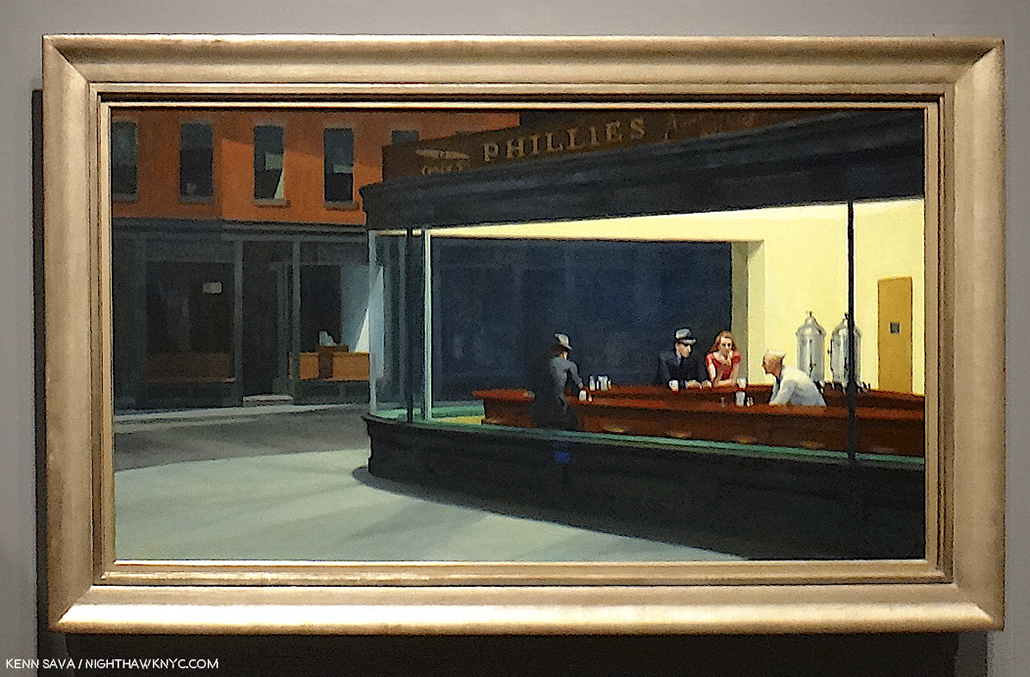
The last time I stood in front of Nighthawks. August 28, 2013, at Hopper Drawing at the old Whitney Museum.

I’ve long identified with Edward Hopper’s Nighthawks, which I’ve seen in person both at its home at the Art Institute of Chicago and here in NYC at the “old” Whitney Museum during the Hopper Drawing show. In particular, the guy in the front who’s sitting by himself, the guy no one ever mentions in discussing this work which is now seminal to our culture and to the Art, Film, Music and Literature that has come after. It’s hard to believe it was painted in 1942. It feels so now. But, I digress, again.

I am that guy.
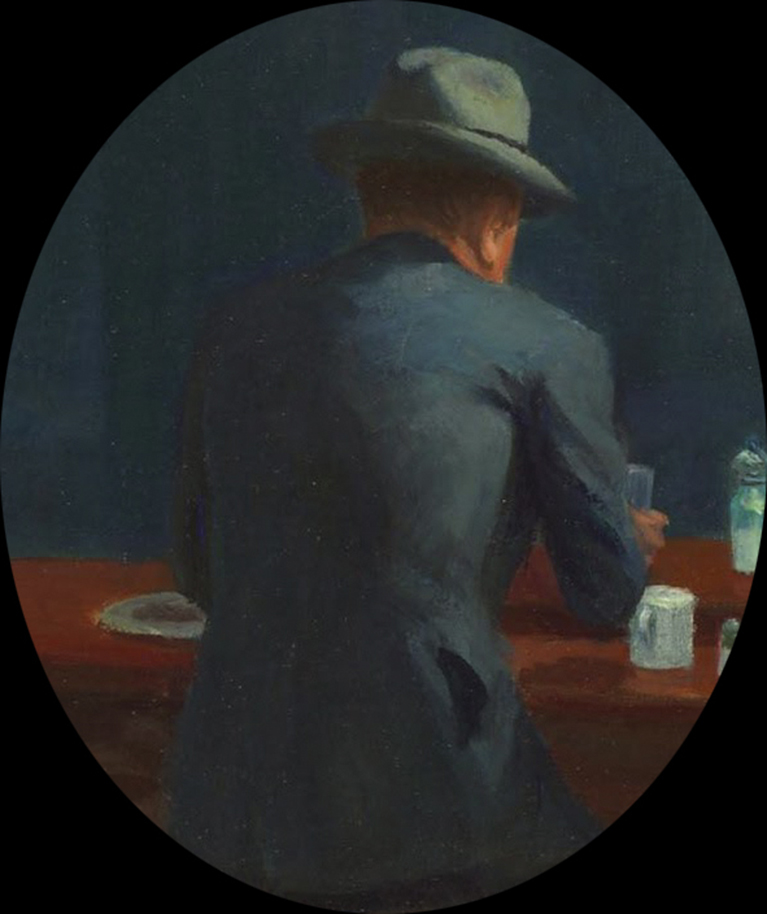
 

*-Detail of Art Institute of Chicago Photo

“That shape is my shade
There, where I used to stand
It seems like only yesterday
I gazed through the glass
At ramblers
Wild gamblers
That’s all in the past.” *

Living in Manhattan was always my life’s dream. And it took a long time for that to finally happen. For the last 28 years, it’s been my world, my “home sweet home,” as Steely Dan said in “Deacon Blues”*, the soundtrack of this post. I’ve lived most of that time in my world at night.

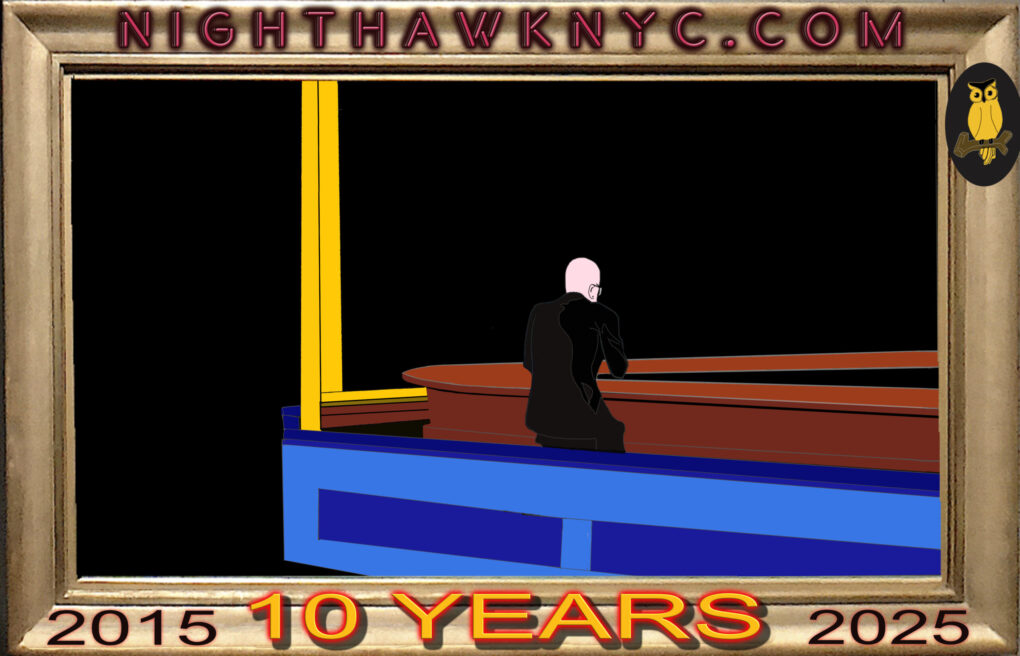
Now? I’m inviting YOU to come along with me. Pull up that open barstool, since there’s now plenty of them to choose from as  you can see from the banner (adopted from you know what, with my apologies. and undying admiration), and let’s see what the night brings.

As Joe Strummer once said, “The future is unwritten.” That leaves the present and the past to write about. One thing I’ve learned along the way- the journey is usually the destination.

“You call me a fool
You say it’s a crazy scheme
This one’s for real
I already bought the dream
So useless to ask me why
Throw a kiss and say goodbye
I’ll make it this time
I’m ready to cross that fine line.” *

*- From the soundtrack for this Post, “Deacon Blues,” Words & Music by Walter Becker and Donald Fagen. Published by Universal Music Publishing Group. From the classic Lp Aja, by Steely Dan.

NighthawkNYC.com has been entirely self-funded & ad-free for 10 years, during which 350+ full-length pieces have been published! If you’ve found it worthwhile, PLEASE donate by PayPal below to allow me to continue. Thank you, Kenn.

You can also support it by buying Art, Art & Photography books, and Music from my collection! Art & Books may be found here. Music here and here.

Written & photographed by Kenn Sava for nighthawknyc.com unless otherwise credited. To send comments, thoughts, feedback or propositions click here. Click the white box on the upper right for the archives or to search them. Subscribe to be notified of new Posts below. Your information will be used for no other purpose.

For “short takes,” my ongoing “Visual Diary” series, and outtakes from my pieces, be sure to follow @nighthawk_nyc on Instagram!